
You can train four days a week and still lose the daily battle if you spend the other ten hours pinned to a chair. Prolonged sitting is not just “lack of exercise.” It changes blood flow, reduces muscle activity, stiffens joints, and pushes your posture into patterns your next workout has to clean up. The damage builds quietly. A desk job rarely feels dramatic in the moment, which is why so many people ignore it until their hips feel locked, their back feels cranky, and their energy drops by midafternoon.
The useful part is simpler than the problem. You do not need a standing marathon, a heroic mobility routine, or expensive office gear to reduce the health cost of sitting all day. What works best is regular interruption. Short movement breaks, better workstation habits, and a few strategic exercises can improve circulation, preserve joint motion, and make your training outside work more productive. At Fitness Warrior Nation, we keep seeing the same pattern: people get better results when they treat desk time like a recovery variable, not a neutral background detail.
The Hidden Cost of Sitting All Day on Your Body
Sitting for hours at a time slows more than your step count. Research has linked prolonged sedentary time with higher risk of cardiovascular disease, type 2 diabetes, and all-cause mortality, even after adjusting for planned exercise. A 2020 scientific statement from the American Heart Association noted that more daily sedentary time is associated with poorer cardiometabolic health, and risk tends to rise further when sitting is uninterrupted for long stretches.
The mechanism is plain enough. Your glutes do less work. Your calves stop acting as a pump. Blood flow drops in the lower body. Hip flexors stay shortened. The thoracic spine drifts into flexion. Over time, the absence of low-level movement becomes its own stressor, especially if your workday repeats that pattern five days a week.
Why Exercise Alone Does Not Fully Offset Desk Time
A hard training session helps. It does not erase eight to ten sedentary hours. A 2020 review in Sports Medicine found that high levels of moderate-to-vigorous physical activity can reduce, but not always fully remove, the health risk tied to prolonged sitting. That matters for people who assume a morning lift cancels a motionless workday.
Your body responds to frequency as much as volume. One 45-minute workout cannot replace the repeated benefit of getting up, walking, reaching, and shifting position throughout the day. Movement snacks beat heroic compensation. That is the practical frame most desk workers need.
If your joints already feel stiff by noon, articles on daily movement and joint health add useful context. The issue is rarely one bad chair. It is the repetition.
The Simple Fix That Works Best: Break Up Sitting Often
The most reliable fix is not complicated. Stand up and move every 30 to 60 minutes for two to five minutes. You do not need to turn each break into exercise class. Walk to the kitchen. Climb a flight of stairs. Do calf raises while the coffee brews. Add a few bodyweight squats. The point is to restore muscle activity and circulation before your body settles deeper into stillness.
This advice lines up with current public health guidance. The CDC and WHO continue to recommend limiting sedentary time and replacing it with movement whenever possible. Small interruptions count. A 2023 review in Medicine & Science in Sports & Exercise also supported frequent activity breaks as a practical way to improve post-meal glucose control, especially after long seated periods.
What to Do During a Two-to-Five-Minute Break
You need options that fit real workdays. Keep them simple enough that you will actually use them.
- Walk for two to five minutes around your office, home, or hallway.
- Do 10 to 15 bodyweight squats to wake up hips and quads.
- Perform 15 to 20 calf raises to help lower-leg circulation.
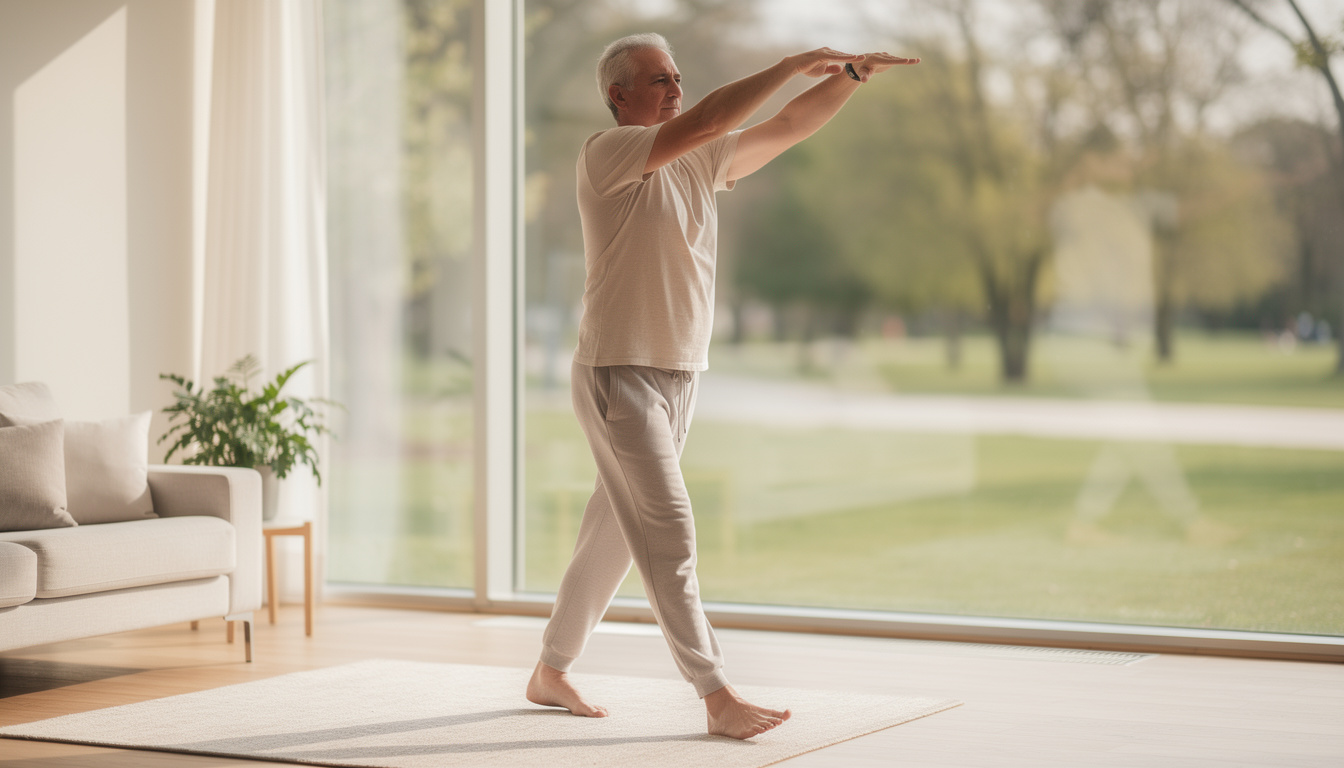
- Reach overhead and rotate your upper back for 30 to 45 seconds per side.
- Stand for phone calls or meetings that do not require typing.
These are not random drills. They counter the exact tissues and systems that get neglected at a desk. Short bouts also feel easier to repeat, which is why they work better than the “I’ll stretch tonight” plan that never survives a long afternoon.
How to Set Up Your Workday So Movement Actually Happens
Good advice fails when it depends on memory alone. The easiest win is to attach movement to events you already have: the end of a meeting, every bathroom trip, each refill of water, or the top of the hour. Behavior sticks faster when it rides on an existing cue.
That is also where equipment can help, though it should support the habit rather than replace it. A sit-stand desk gives you more position variety. An under-desk machine can increase light activity during email blocks or long calls. If you want a low-friction option, this look at an under-desk elliptical for office movement shows why some people find compliance easier when the tool stays within reach.
Standing More Is Useful, but Variety Matters More
Standing all day is not the answer either. Static standing can irritate the low back, feet, and calves if you never change position. The target is variety: sit, stand, walk, shift, reach, then repeat. Your tissues tolerate changing loads better than one rigid posture held for hours.
This is where many people overcomplicate the problem. You do not need perfect posture frozen in place. You need a workstation that lets you move often, plus enough strength and mobility to handle normal life. If your weekly plan neglects that balance, this guide on strength and flexibility in workouts is worth a read.
| Workday Situation | Common Problem | Simple Fix That Works |
|---|---|---|
| Two-hour email block | Neck stiffness and low movement | Stand once midway and walk for three minutes |
| Back-to-back video meetings | Collapsed posture and hip tightness | Take one meeting standing and add calf raises off camera |
| Long afternoon slump | Lower energy and reduced focus | Five-minute brisk walk after lunch or before the next task block |
| Home office with little space | Too few movement options | Use a timer and rotate squats, reaches, and hallway walks |
Notice what these fixes share: none require motivation at elite-athlete levels. They rely on friction reduction, not willpower.
The Training Effect You Notice First Is Not Weight Loss
People often ask whether these micro-breaks help body composition. They can contribute, but the first payoff is usually better comfort and better training quality. When you sit less during the day, your hips often move more freely, your back feels less compressed, and your warm-up stops feeling like a salvage operation.
This matters if you lift, run, or do classes after work. A body that has been folded into a chair for nine hours usually needs more prep to reach good positions. Break up sitting during the day, and your evening session often feels smoother. The result is indirect but real: more consistent workouts, fewer skipped sessions, and less energy wasted fighting stiffness.
There is also a bodyweight-management angle. Extra walking and light activity raise total daily energy expenditure, though the effect varies by body size and pace. If that is part of your goal, this piece on practical fitness habits for weight loss fits well with the same principle: boring consistency tends to outperform dramatic plans.
Bottom Line
Sitting all day carries a real physiological cost.
One workout does not fully cancel uninterrupted desk time.
The fix is regular interruption: stand, walk, squat, reach, repeat.
Variety in posture beats forcing yourself to stand still longer.
The best plan is the one your workday can actually absorb.
How often should I get up if I sit all day at work?
A practical target is every 30 to 60 minutes, with two to five minutes of movement each time. If your schedule is packed, even one to two minutes helps, and wearable prompts or calendar reminders often improve follow-through more than motivation alone.
Is standing at my desk enough to undo the effects of sitting?
Standing helps, but it is not a complete fix if you stay still for long periods. Light walking and repeated posture changes usually do more for circulation and stiffness than replacing one static position with another.
Can short walking breaks improve blood sugar after meals?
Yes, especially after lunch or dinner. Several studies have found that brief post-meal walks can improve glucose handling, and the effect appears useful even when the walk lasts only a few minutes at an easy pace.
What if I already exercise every day but still feel stiff from desk work?
That is common because training volume and movement frequency are different variables. Add mobility-friendly breaks during the workday, and consider checking screen height, chair depth, and keyboard position so your setup stops feeding the same tight areas every day.