
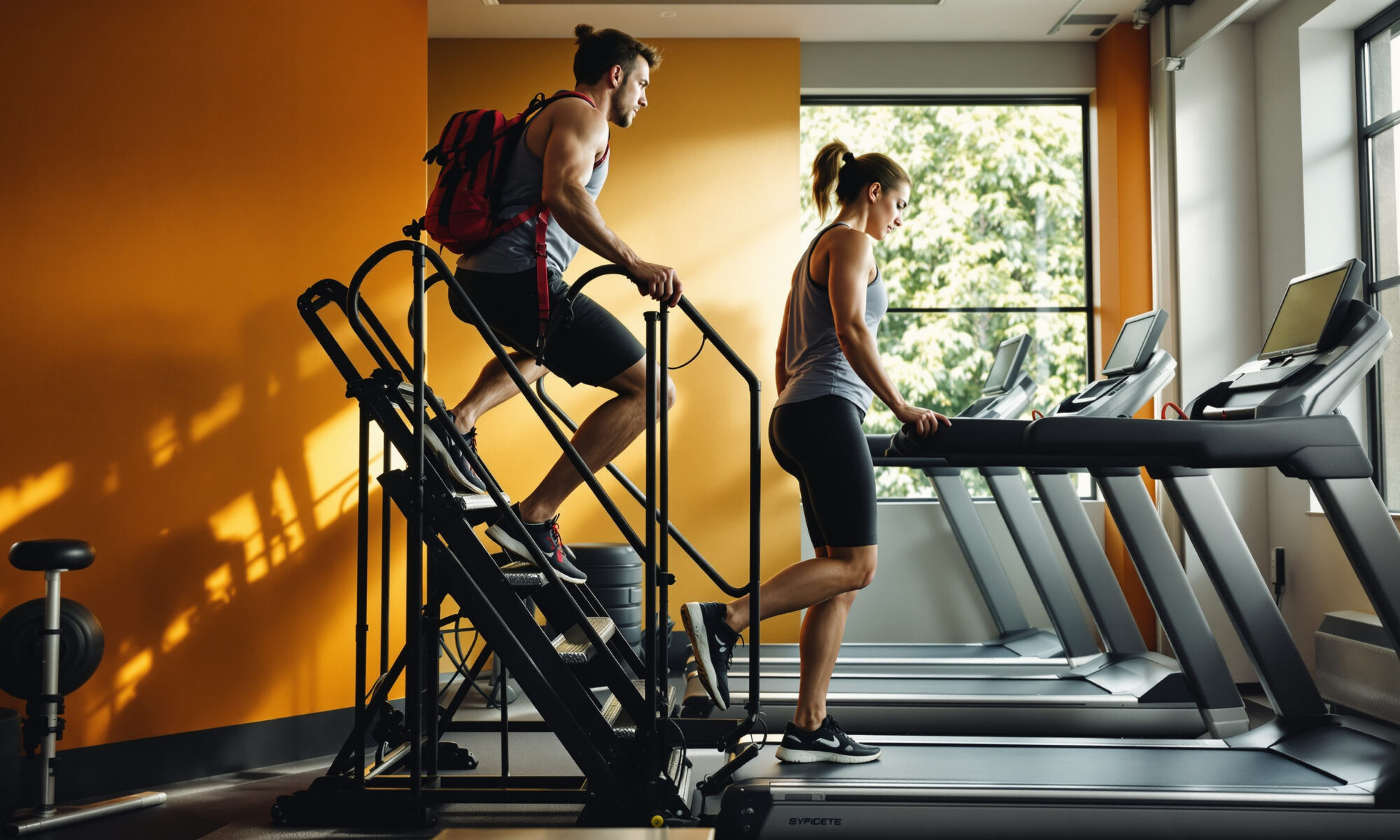
A stair climber workout is usually the harder conditioning option at a comparable perceived pace, while incline walking offers finer control over speed, grade, and fatigue. The 2024 Adult Compendium assigns 9.3 METs to a stair treadmill ergometer, but it provides no equivalent speed-by-grade value for forward incline walking. So, no: research doesn’t establish one machine as categorically better.
Stair climber workout vs incline walking: the evidence
A MET expresses an activity’s energy cost relative to rest. The 2024 Adult Compendium of Physical Activities lists a general stair treadmill ergometer at 9.3 METs, up slightly from 9.0 METs in its 2011 edition. General stair climbing is listed at 6.8 METs, with entries spanning 4.5 METs at a slow pace to 9.3 METs at a fast pace.
Level treadmill walking is lower: the 2024 Compendium walking category assigns 3.8 METs at 3.0–3.4 mph, 4.8 METs at 3.5–3.9 mph, 5.8 METs at 4.0–4.4 mph, and 6.8 METs at 4.5–4.9 mph. That doesn’t prove a stair machine burns more calories than steep incline walking because the Compendium doesn’t publish a forward incline-walking entry organized by both speed and grade.
MET values are standardized estimates, not measurements from your individual session. Body mass, machine calibration, fitness, technique, and rail use all affect actual expenditure. A 70 kg person exercising for 30 minutes at a theoretical 9.3 METs would expend roughly 342 kcal using the standard MET equation, but treating that as a guaranteed machine readout would be false precision.
| Comparison | Stair climber | Incline treadmill walking |
|---|---|---|
| 2024 Compendium value | 9.3 METs for general stair treadmill ergometer | No forward speed-by-grade MET entry |
| Closest documented range | 4.5–9.3 METs for stair climbing | 3.8–6.8 METs for level walking at 3.0–4.9 mph |
| Main contributors | Vasti, plantarflexors, gluteus maximus, hamstrings | Hip, knee, and ankle extensors; contribution rises with grade |
| Biomechanical evidence | Repeated vertical propulsion on moving steps | Lower peak knee-abduction moment at most 5–20% grades versus 0% in a 2014 study |
| Best practical fit | High work rate in 10–30 minutes | Precisely controlled 0–20% grade and walking speed |
Which muscles do the two machines train?
Stair ascent demands repeated vertical propulsion. Modeling published in 2017 identified the vasti, the quadriceps muscles surrounding the femur, and the ankle plantarflexors as principal contributors to that task. The gluteus maximus and hamstrings contributed substantially to forward propulsion.
Incline walking shifts more mechanical work toward the lower-body joints as the slope rises. In a 2019 treadmill study of only 10 men, positive work increased at the hip, knee, and ankle at 6, 12, and 20 degrees. Hip positive work rose by 153%, 280%, and 453%, respectively, compared with level walking.
Those large percentages describe joint mechanics in a small laboratory sample, not muscle growth. Neither machine replaces loaded squats, split squats, hinges, or calf raises if hypertrophy is your priority. For a clearer resistance-training framework, see our guide to building the glutes with progressive strength work.
A so-called glute-focused stair climber workout can change where you feel the effort, but sensation isn’t proof of greater glute growth. Taking controlled steps and extending the hip without hanging from the console is reasonable. Exaggerated forward folding or skipping multiple steps usually trades useful output for awkward positioning.
Joint load is more complicated than “low impact”
Both machines avoid the flight phase and landing collision found in running. Still, “low impact” doesn’t mean low muscular or joint demand. Your knees, hips, ankles, and calves must repeatedly produce force to lift your body uphill.
A 2014 treadmill study using 0%, 5%, 10%, 15%, and 20% grades found that incline walking reduced peak internal knee-abduction moment versus level walking at most tested grades. That measure is relevant to frontal-plane knee loading, but it isn’t a measurement of total knee-joint force and shouldn’t be interpreted as proof that steeper is always safer.
Stair ascent also creates a balance demand that gets overlooked. A 2026 Experimental Gerontology study of 108 healthy adults found lower side-to-side dynamic stability during stair ascent in older adults than in young and middle-aged adults. The older group also showed higher activation in several lower-leg, hamstring, and hip muscles, although the study didn’t compare stair machines with incline treadmills.
If you have persistent knee pain, impaired balance, recent surgery, or a cardiovascular condition, get individualized guidance from a qualified clinician before forcing either modality. For everyone else, symptoms during and after training are more useful than blanket claims that one machine is “good” or “bad” for knees.
Stop letting the handrails do the workout
Rail support can materially reduce the work. In a 2006 study of 10 healthy adults, gripping treadmill handrails lowered oxygen uptake from 20.3 to 17.2, 23.8 to 18.0, and 26.1 to 20.6 mL/kg/min across three steady-state intensities. Resting the hands on the rails also reduced oxygen uptake, though less than gripping.
That trial involved treadmill exercise, not a stair climber, and its sample was small. The transferable principle is still sensible: unloading body weight through your arms lowers the demand placed on your legs. Honestly, a slower setting completed upright is more credible than a high display level survived by hanging on the console.
Use a light fingertip touch when you need help stepping on, changing controls, or regaining balance. If you require continuous heavy support, reduce the level, speed, or grade. The machine number is a setting, not a score.
Try three practical 20-minute sessions
No machine-specific trial establishes a universal 20-minute steady, interval, or glute-focused protocol. These are programming examples, not research-validated prescriptions. They use rating of perceived exertion, or RPE, because “level 8” can represent very different workloads across machines and users.
- Steady aerobic session: Warm up for 3 minutes at RPE 3–4, work for 14 minutes at RPE 5–6, then cool down for 3 minutes at RPE 2–3. You should be breathing harder but still able to speak in short sentences. Choose either machine and keep hand support minimal.
- Controlled intervals: Warm up for 4 minutes, then complete 6 rounds of 1 minute at RPE 8 followed by 1 minute at RPE 4. Cool down for 4 minutes. This resembles the hard-easy logic used in other interval methods, although it isn’t the same as the research-based Norwegian 4×4 protocol.
- Hip-extension emphasis: Warm up for 3 minutes, alternate 2 minutes of controlled climbing at RPE 6 with 1 minute at RPE 4 for 15 minutes, then cool down for 2 minutes. Keep your torso stable, place the full foot when the step depth permits, and drive through each step without pushing down on the rails.
Progress one variable at a time. Add 1–2 working minutes until you can complete 20–30 minutes with stable technique, then make a small speed, level, or grade increase. If RPE rises by two points at the same setting, accumulated fatigue, heat, poor sleep, or inadequate fueling may be the real issue.
Two weekly cardio sessions can sit comfortably beside strength training for many lifters, but hard stair intervals immediately before heavy squats are a poor pairing. A combined strength and cardio plan can help you separate demanding lower-body sessions. If you prefer treadmill structure, our review of the 12-3-30 incline workout explains what that popular prescription can and can’t do.
Choose the machine that fits the job
Pick the stair climber when you want a high work rate in limited time and can climb without leaning heavily on the rails. It’s also useful when sustained level walking no longer challenges your cardiovascular system at a practical speed. Expect local fatigue in the calves, quadriceps, and glutes to limit some sessions before your breathing does.
Choose incline walking when you need smaller workload adjustments, want to accumulate longer aerobic sessions, or find continuous stepping too fatiguing for your calves and knees. The treadmill is generally easier to regulate because speed and grade can be adjusted independently. That makes it the better default for many recovery days.
For fat loss, neither machine has a special metabolic advantage. The useful option is the one that lets you accumulate repeatable weekly work without degrading lifting performance or provoking symptoms. If your broader question is how hard cardio should be, the comparison of Zone 2 and interval training is more consequential than the machine logo.
Stair climber workout FAQ
How long should a stair climber workout be?
Start with 10–20 minutes at a sustainable RPE and build toward 20–30 minutes if technique remains stable. Duration should reflect your training status and weekly workload, not a universal calorie target.
Is a stair climber better than incline walking for fat loss?
No direct head-to-head trial identified through November 10, 2026 establishes a universal winner. A stair machine may produce a higher work rate, but fat loss depends more on sustained energy balance, adherence, and total activity.
Does the stair climber build glutes?
Stair ascent recruits the gluteus maximus, but evidence doesn’t show that machine climbing builds glutes as effectively as progressive resistance training. Treat it primarily as conditioning with lower-body muscular demand.
Can you do a stair climber workout every day?
You can perform easy climbing frequently if you recover well, but daily hard sessions can accumulate calf, knee, and hip fatigue. Alternate intensities and reduce volume when soreness changes your gait or lifting technique.
Why do my calves fatigue before I get out of breath?
The plantarflexors are major contributors to vertical propulsion during stair ascent. Lower the setting, avoid staying high on your toes, and build duration gradually rather than using the rails to bypass local fatigue.