

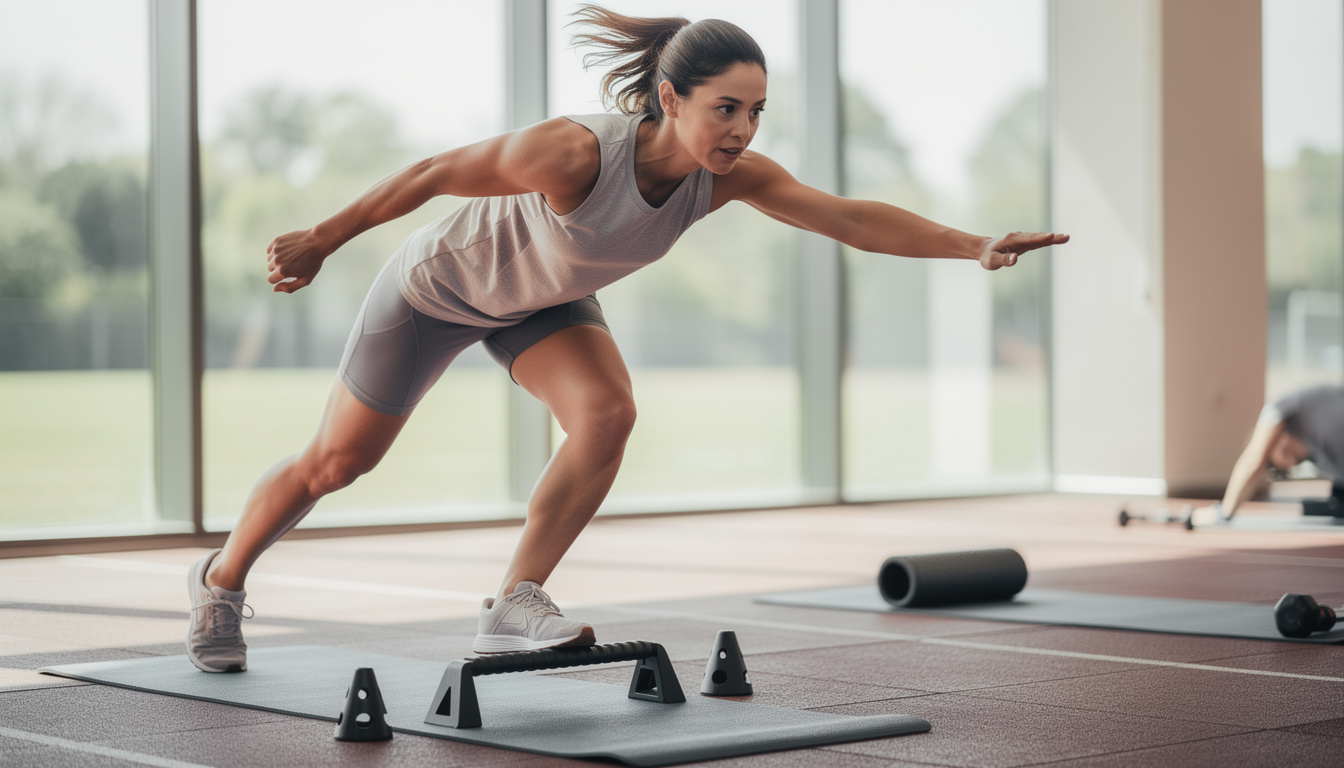
Aitana Bonmatí’s fitness stands out because it looks efficient before it looks dramatic. Her game relies on repeat sprint ability, sharp changes of direction, constant scanning, and the aerobic base to keep making clean decisions late in a match. That mix matters more than highlight-reel speed alone. In elite soccer, midfielders cover substantial ground with frequent accelerations and decelerations, and performance depends on how well they recover between those efforts, not only how hard they can push once.
Bonmatí offers a useful case study because her profile points to agility built on control, endurance built on pacing, and recovery built on restraint. Public reporting, match demands, and modern women’s soccer performance standards all suggest the same lesson: top form comes from layered preparation, not from random intensity. You will see how her likely training profile works, why natural density matters in repeated match actions, and what recreational athletes can borrow without pretending they train like a Ballon d’Or winner.
Aitana Bonmatí’s Game Fitness Starts With Match Demands
Bonmatí plays a position that punishes inefficiency. Central midfield requires constant movement across short and medium distances, quick body orientation changes, and enough composure to execute technical actions under fatigue.
That makes natural density a useful lens. In practical terms, it means how much high-quality movement, effort, and skill a player can pack into a match without obvious drop-off. The phrase is not a formal sports science term, but it helps describe why some players seem present in every phase without looking rushed.
Why Agility in Soccer Is More Than Foot Speed
Agility in soccer includes deceleration, reacceleration, hip control, balance, and visual processing. A player who can stop cleanly often creates more separation than one who only runs fast in a straight line.
Bonmatí’s style suggests this exact quality. She changes tempo well, keeps her center of mass under control, and uses small directional shifts to open passing lanes. That is a more durable form of agility than flashy cone work alone.
Research supports that distinction. A 2024 consensus review in the British Journal of Sports Medicine on change-of-direction performance noted that eccentric strength, braking mechanics, and technique shape cutting performance as much as raw speed. For a midfielder, that has tactical value every few seconds.
That same logic shows up across broader fitness coverage. At Fitness Warrior Nation, reporting on fitness club social wellness has highlighted how sustainable performance usually comes from repeatable habits and environment, not novelty. Elite sport applies the same rule with higher stakes.
Endurance Means Decision Quality, Not Just Distance Covered
Soccer endurance is rarely about cruising at one pace. It is about recovering after intense actions, then making another precise action before the game moves on.
Elite women’s soccer data show players perform repeated high-speed efforts across 90 minutes, with midfielders facing large total running loads plus frequent tactical transitions. Governing-body and club performance reports vary by team and system, but the pattern is stable: the aerobic base supports repeated anaerobic work.
This is where natural density becomes useful again. A player with better aerobic support can stack more quality actions with less visible drift in technique. You see it in late pressing, second-ball reactions, and the first touch after a recovery run.
How Smart Training Builds Agility and Endurance Together
Bonmatí’s public image is built on poise, but poise in competition usually rests on a heavy physical foundation. The likely ingredients are familiar in elite soccer: strength work, multidirectional speed training, ball-based conditioning, and carefully managed running exposure.
For most readers, the main lesson is simple. You should train qualities that transfer to your sport or goal, then recover well enough to repeat them.
The Physical Traits That Likely Support Her Style
A midfielder with Bonmatí’s profile likely depends on several overlapping capacities rather than one standout metric. These qualities usually matter most:
- Eccentric lower-body strength for braking and reacceleration
- Single-leg stability for cutting, passing, and contact balance
- Aerobic capacity to restore energy between repeated efforts
- Repeated sprint ability for pressing and transition moments
- Core and pelvic control to keep technical actions clean under fatigue
ACSM guidance on field-sport conditioning and repeated sprint research both support this layered model. Sprint quality fades quickly when strength, aerobic support, and recovery all sit in separate silos. The better approach combines them across the week.
Why Strength Training Helps a Skill Player
Strength work does not make a technical player less fluid. Used well, it improves force production, tissue resilience, and positional control during chaotic actions.
A 2022 review in Sports Medicine found that resistance training improves sprint, jump, and change-of-direction qualities in soccer players, with stronger effects when programs include high-velocity intent and sport-specific integration. That matters for a player whose game depends on winning small spaces.
Natural density also shows up here. A stronger athlete can often maintain mechanics across more reps and more match minutes before fatigue starts to erode precision.
If you follow the business side of training culture, the expansion stories around facilities and programming matter too. Pieces on fitness leader invests in Raleigh and the DonaMatrix Fitness Festival reflect the same shift: people want smarter systems, not louder workouts.
Smart Recovery Keeps High Performance Available
The most underrated part of game fitness is often what happens after the session. Recovery does not exist to make you feel virtuous. It exists to restore output.
For elite soccer players, that usually includes sleep, nutrition, hydration, tissue care, low-intensity movement, and training-load management. Recovery is not passive if the schedule includes travel, matches, media duties, and tactical sessions.
Why Smart Recovery Beats Constant Intensity
High performers rarely train at maximum intensity every day because that would erode the very quality they need on game day. Match congestion in soccer has made this clearer over the last decade.
A 2023 review in International Journal of Sports Physiology and Performance on recovery in team sports reported that sleep quantity and quality strongly influence subsequent sprint performance, reaction time, and perceived fatigue. For a midfielder, those effects spill directly into decision speed.
Nutrition also matters, especially carbohydrate availability around hard sessions and protein intake across the day. Broad sports nutrition guidance from the International Olympic Committee and ACSM often places daily protein needs for trained athletes around 1.2 to 2.0 g/kg of body weight, depending on training load. If you have kidney disease, are pregnant, or use medication that affects fluid balance, talk to a clinician before changing supplements or hydration strategies.
A Practical Model for Recreational Athletes
You do not need a pro staff to apply this. You need structure, restraint, and enough honesty to stop treating fatigue like a personality trait.
| Goal | Practical Weekly Focus | Why It Works |
|---|---|---|
| Agility | 1-2 sessions of cutting, deceleration, and lateral mechanics | Builds control before speed and reduces sloppy movement under fatigue |
| Endurance | 2 aerobic sessions, one steady and one interval-based | Supports repeat efforts and better recovery between hard actions |
| Strength | 2 full-body sessions with split squats, hinges, pushes, and pulls | Improves braking, force transfer, and tissue tolerance |
| Recovery | 7-9 hours of sleep, easy movement, and one lower-load day | Keeps quality available instead of burying it under fatigue |
The insight is straightforward. Fitness that shows up in real play is fitness you can repeat.
What Bonmatí’s Profile Teaches About Natural Density
Bonmatí’s game points to a performance trait many athletes miss. The goal is not to chase isolated outputs. The goal is to sustain useful output across the whole contest.
That is why natural density belongs in the discussion. Used carefully, it describes how efficiently an athlete distributes effort, recovers between actions, and keeps technical quality available. In soccer terms, that means fewer empty runs, cleaner late-match touches, and better decisions after the hard sprint.
Fitness Warrior Nation readers who follow coverage of shifting training models will recognize this pattern. The same principle that separates durable performers from drained ones also shapes how modern gyms program group work, recovery spaces, and hybrid conditioning.
Quick Takeaways
Agility depends on braking control as much as foot speed.
Endurance supports decision quality late in the match.
Strength helps preserve mechanics under repeated stress.
Smart recovery keeps performance available across the week.
Natural density explains why some players stay effective without looking frantic.
Questions Readers Usually Ask About Aitana Bonmatí’s Fitness
How does Aitana Bonmatí stay effective late in games?
Her style suggests a strong aerobic base, efficient movement, and disciplined pacing. Midfielders who scan early and reposition well often save energy for decisive actions, which is a performance skill as much as a conditioning trait.
Is Aitana Bonmatí’s fitness built more on speed or endurance?
It is better described as a blend, with endurance supporting repeated bursts of speed. In match analysis, the ability to accelerate, recover, and then execute a technical action often matters more than top-end sprint numbers alone.
What can amateur players copy from Bonmatí’s training approach?
Most players should borrow the structure, not the volume. Two strength sessions, one agility-focused field session, and one interval conditioning day each week can improve repeat effort capacity without copying elite workloads.
Does recovery really improve agility and endurance?
Yes, because fatigue changes mechanics and slows processing speed. Even mild sleep restriction can reduce reaction time and repeated sprint performance, which means recovery affects movement quality as well as energy levels.