Ilona Maher has become a useful case study in how strength culture is changing. Her public image does not center on stage-lean aesthetics or gym theatrics. It centers on power that transfers: sprinting through contact, holding position, accelerating again, and doing it under fatigue. That matters because more readers now want training that improves daily movement, sport performance, and long-term resilience, not just mirror metrics. Maher’s appeal sits right inside that shift.
Her example also sharpens a larger point. Functional power is not a vague social-media label. It is a training outcome built from force production, coordination, trunk stiffness, repeatability, and enough conditioning to express strength when tired. You will walk away with a clearer view of what Maher’s approach appears to represent, why this model is spreading well beyond rugby, and how to apply the same principles without pretending you are preparing for an international test match.
Ilona Maher’s Strength Approach Reflects a Different Fitness Ideal
Maher, a standout in USA Rugby sevens and later in the 15s setup, has helped push a more practical image of female strength into mainstream sports coverage. Public interviews, match footage, and team training clips point to an athlete built for collision, speed, and repeat effort. That combination changes the conversation. The goal is not to look capable. The goal is to be capable on demand.
For years, popular strength content split into neat categories: bodybuilding for appearance, powerlifting for numbers, cardio for endurance. Field sports never fit those boxes very well. A rugby player needs lower-body force, upper-body robustness, rotational control, and enough aerobic support to keep producing high-quality efforts late in a match. Maher’s profile makes that mixed demand visible to a wider audience, especially women who have spent years being sold lighter dumbbells and smaller goals.
At Fitness Warrior Nation, that shift lines up with broader interest in real-world strength training and athletic movement quality. The appeal is easy to understand. Functional power asks what your strength can do, not only how much load you can move in one controlled pattern.
Why Her Model Resonates Beyond Rugby
Maher’s visibility matters because the template scales. A contact-sport athlete trains at high intensity, but the underlying traits are useful for many people: bracing under load, changing direction well, carrying force through the trunk, and recovering between hard bouts. A parent lifting a heavy stroller, a nurse spending hours on their feet, and a recreational athlete chasing weekend performance all benefit from some version of that profile.
The cultural side matters too. Women’s strength coverage has often swung between caution and spectacle. Maher lands somewhere more useful. She presents strength as competence. That is one reason readers interested in women and strength training keep returning to this category of athlete as a reference point.
To see the broader training backdrop, it helps to watch how coaches talk about rugby preparation and field-based power.
What Functional Power Actually Means in Training
Functional power gets abused as a marketing phrase, so it needs a stricter definition. In practice, it means producing force quickly in patterns that matter for your sport or life, then repeating that output without your mechanics falling apart. That usually blends maximal strength work, explosive training, unilateral patterns, trunk stability, and energy-system conditioning.
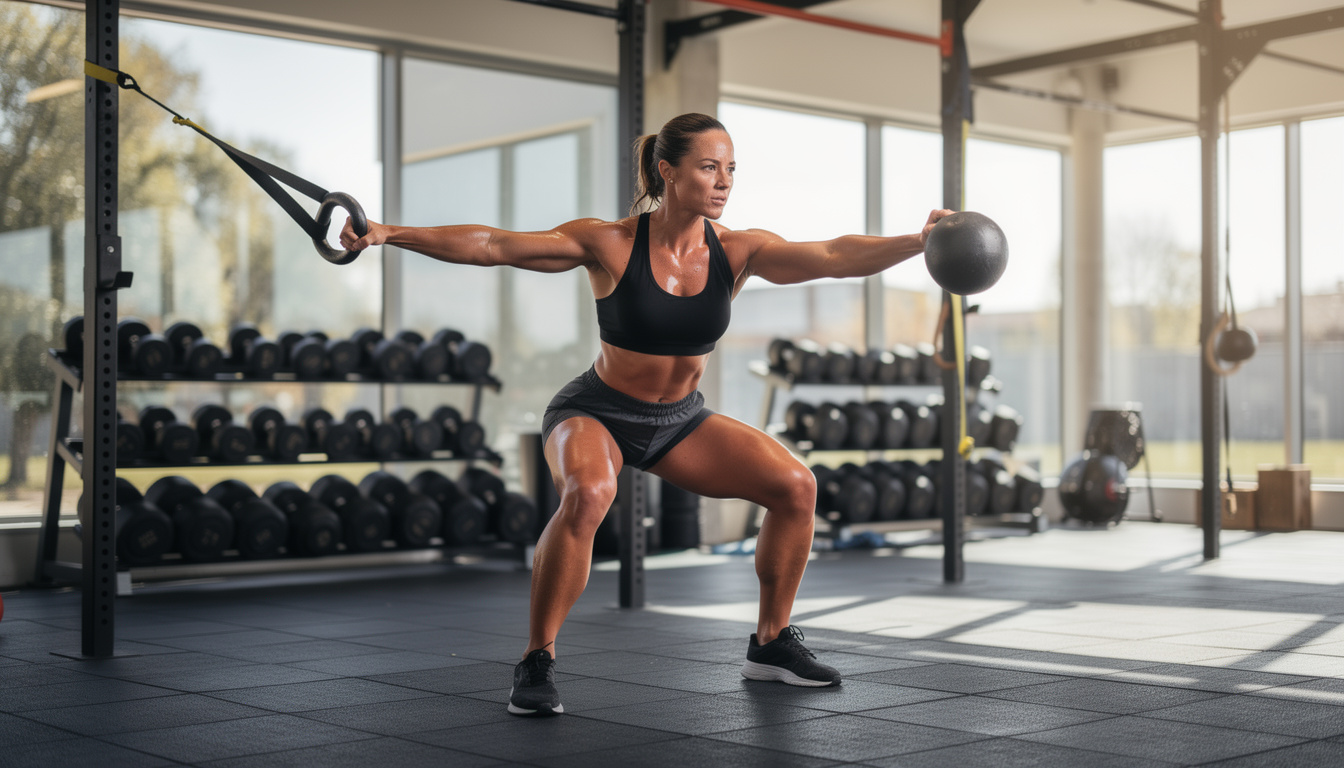
For a rugby player, this could mean heavy squats or trap bar deadlifts, loaded carries, sled work, jumping, sprinting, and contact-prep drills. For a general trainee, the menu changes but the logic holds. You train to create force, absorb force, and transfer force across positions. The body does not move in isolated muscle-group diagrams once real speed or fatigue enters the room.
This is where the term natural density can be useful if you define it carefully. In a training context, natural density describes a look and feel that comes from layered athletic qualities rather than physique specialization alone. A body built through carries, sprints, split squats, pulls, and repeated efforts often has that compact, capable appearance. It is not a formal scientific term, but it captures why athletes like Maher look powerful without resembling bodybuilders.
Why Transfer Matters More Than Exercise Novelty
Functional training does not mean balancing on a half-inflated ball while curling a kettlebell. Transfer matters more than novelty. The question is simple: does the drill improve your ability to apply force in the tasks you actually perform?
Research supports the broad outline. The American College of Sports Medicine recommends resistance training for strength and power development, with exercise selection matched to goals and movement demands. For power, ACSM position guidance has long favored intent, velocity, and appropriate loading rather than random complexity. In sport settings, studies on ballistic training, plyometrics, and sprint work consistently show that high-force and high-velocity training together produce better athletic transfer than either one alone.
A 2023 review literature across team sports also reinforced a point coaches already knew: repeated sprint ability and change-of-direction performance depend on more than leg strength alone. Trunk control, stiffness at the right moments, and conditioning support all shape how well you can use that strength. The body is one system under pressure. That is the insight most social-media programs skip.
Core Strength Is Part of the Story, Not the Whole Story
Maher’s game makes another point visible. A strong trunk is not about visible abs. It is about resisting collapse while the limbs create force around it. In rugby, that shows up in tackles, carries, deceleration, and body position through contact. In gym terms, anti-rotation, anti-extension, and loaded carry work matter because they improve how force travels across the body.
That is also why many readers pair this topic with powerful core training and broader guides to functional training methods. The point is not to chase complexity. The point is to build a body that holds shape while moving fast.
How to Build Functional Power Without Training Like a Professional Rugby Player
You do not need a national-team schedule to train for useful power. You need clear priorities, enough load to drive adaptation, and enough restraint to recover. Most non-professional trainees get better results from a simple weekly structure than from copying elite-athlete highlight clips.
A practical setup usually includes three layers: one or two main strength lifts, one explosive element early in the session, and accessory work that improves single-leg strength, posture, and trunk control. Then you add conditioning that matches your recovery capacity. A desk-bound adult with three training days per week needs a very different dose than a field athlete practicing several times weekly.
- Main strength: trap bar deadlift, front squat, or rear-foot elevated split squat for 3-5 sets of 3-6 reps.
- Power work: box jumps, med-ball throws, kettlebell swings, or short sled pushes for 3-6 crisp sets.
- Support work: rows, presses, carries, Copenhagen planks, and anti-rotation drills for controlled volume.
- Conditioning: tempo runs, bike intervals, or short shuttle efforts, adjusted to your joints and schedule.
This kind of plan builds natural density through useful qualities, not through endless fatigue. You finish sessions feeling trained, not flattened. That distinction matters because sustainable power comes from repeatable work blocks, not dramatic single workouts.
What Busy Adults Can Borrow From the Model
The best borrow from elite sport is structure, not volume. Professional athletes have staff, treatment access, and years of training history. You probably have a job, spotty sleep, and maybe one free hour. Work with that reality.
For many people, the smart adaptation is two strength sessions and one conditioning session each week. If you are over 40 or returning after time off, lower-impact options such as loaded carries, bike intervals, and step-up variations often make more sense than aggressive plyometrics. Fitness Warrior Nation readers who follow coverage on strength strategies for women over 40 and training for older adults will recognize the pattern: keep intensity purposeful, but keep exercise choices honest.
If you have a history of knee, back, or ankle issues, talk to a physical therapist or qualified coach before adding high-impact work. Power training helps many people, but the right entry point varies.
| Training Goal | Best Emphasis | Useful Exercise Examples | Common Mistake |
|---|---|---|---|
| General Functional Power | Strength plus speed | Trap bar deadlift, box jump, sled push, carry | Using fatigue as the main marker of progress |
| Field Sport Performance | Acceleration, deceleration, repeat effort | Split squat, med-ball throw, sprint, lateral shuffle | Skipping conditioning support |
| Busy Adult Resilience | Joint-friendly power and trunk control | Step-up, kettlebell swing, farmer carry, rower intervals | Copying pro-athlete volume |
| Healthy Aging | Balance, leg strength, rate of force development | Sit-to-stand, loaded carry, low box step-up, medicine ball toss | Avoiding power work entirely |
The Rise of Functional Power Is Also a Cultural Correction
Part of Maher’s relevance has little to do with sets and reps. She represents a public appetite for a different standard of athleticism. The old split between “strong” and “feminine” has weakened because more women now see performance as a valid training target, and more audiences understand that strength can look many ways.
This cultural correction has practical effects. Coaches are programming more carries, jumps, throws, and sprint mechanics for general populations. Recreational trainees are asking better questions. Instead of chasing random calorie burn, they want to know if a program improves speed, balance, durability, and confidence in movement. That is a healthier frame.
There is also a body-image angle worth naming. Natural density appeals because it reflects what training can build over time without requiring physique-sport behavior. You can pursue visible muscle and practical power together, but the methods differ from peak-shredded photo-shoot prep. Extreme deficits, rapid weight cuts, and chronic underfueling can compromise performance and raise RED-S risk, especially in sport settings. Performance bodies usually come from enough food, enough recovery, and years of repeat work.
Quick Takeaways
Functional power means force you can use, not just display.
Ilona Maher’s example resonates because it ties strength to performance and resilience.
Natural density comes from layered athletic qualities, not one-dimensional training.
Most adults need simple structure, not elite-athlete volume.
What kind of training likely supports Ilona Maher’s style of strength?
Publicly visible rugby preparation suggests a mix of lower-body strength, sprint work, trunk training, upper-body pushing and pulling, and repeated-effort conditioning. In team settings, that usually also includes contact-prep drills and deceleration practice, which are rarely emphasized enough in standard gym programs.
Can functional power help if I do not play sports?
Yes, because power supports tasks that depend on quick force production, such as climbing stairs fast, catching balance, or lifting awkward objects safely. Research on aging and performance also shows that rate of force development tends to decline earlier than maximal strength, so some power work has value well before old age.
Is functional training better than traditional strength training?
The better choice depends on your goal, but most people do well with both. Traditional lifts build force capacity, while functional power work teaches you to express that force faster and in more varied positions, which is one reason many coaches combine them instead of treating them as rivals.
How many days per week should I train for functional power?
Three days per week is enough for many adults if the sessions are structured well. A common starting point is two strength-power sessions and one conditioning day, with at least 48 hours between harder lower-body efforts if jumping or sprinting is involved.