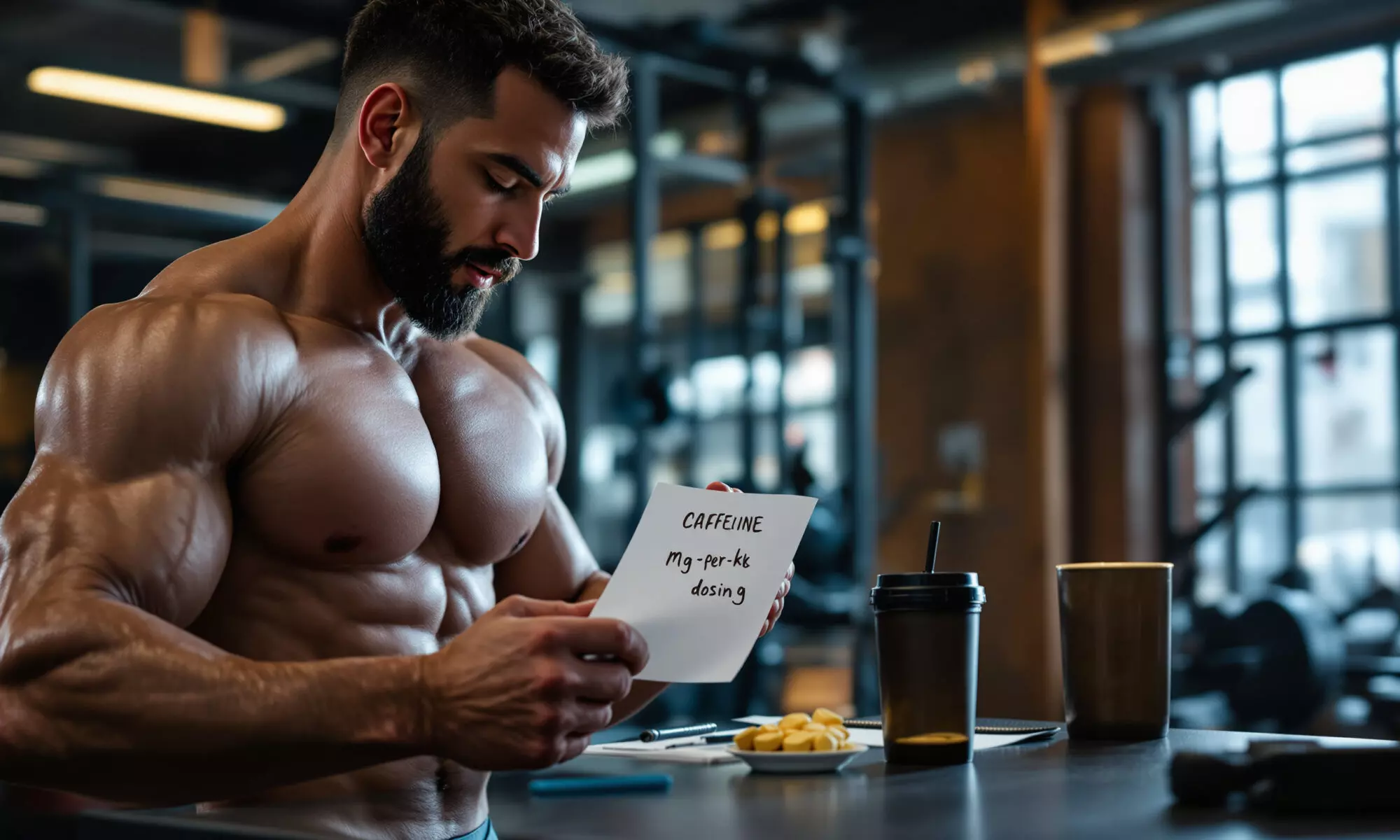
Caffeine before workout dosage is simpler than most pre-workout marketing makes it sound. The best-supported protocol is 3 to 6 mg per kg of body weight taken about 30 to 60 minutes before training, based on the 2018 IOC consensus and the 2021 ISSN position stand. Lower doses under 3 mg/kg can still help some people, especially for endurance or if you’re sensitive, while higher doses raise side-effect risk faster than they raise performance.
What the research actually supports
If you want the short version, start near 3 mg/kg, not 6. That gets you into the evidence-backed range without jumping straight to the dose most likely to wreck your sleep or make your heart race through warm-ups.
Across position stands, systematic reviews, and meta-analyses from 2018 to 2026, the most consistent acute ergogenic protocol is anhydrous caffeine at 3 to 6 mg/kg around 60 minutes before exercise. That applies across endurance, repeated-sprint work, muscular power, and many resistance-training outcomes, though the effect size is usually modest rather than dramatic.
For performance, the gains are real but not magical. Reviews cited by the IOC and later evidence syntheses generally report endurance and time-trial improvements around 1 to 7%, while anaerobic, repeated-sprint, and power outcomes tend to show small-to-moderate benefits, sometimes above 3% depending on the task, training status, and dose.
That means caffeine matters most when the rest of your setup is already decent. Honestly, if your training is random and your sleep is bad, caffeine can make a workout feel sharper, but it won’t rescue a poor program.
Caffeine before workout dosage by body weight
The practical way to dose caffeine is simple multiplication: body weight in kilograms times mg/kg. This is the part many articles skip, so here’s the concrete translation.
| Body weight | 3 mg/kg dose | 6 mg/kg dose | Example practical range |
|---|---|---|---|
| 60 kg | 180 mg | 360 mg | 180-240 mg |
| 70 kg | 210 mg | 420 mg | 200-300 mg |
| 80 kg | 240 mg | 480 mg | 240-320 mg |
| 90 kg | 270 mg | 540 mg | 270-360 mg |
| 100 kg | 300 mg | 600 mg | 300-400 mg |
The first two numeric columns are the research-based range. The last column is what I’d do in practice for most lifters: begin in the lower half, because plenty of people get the performance upside without needing the full 6 mg/kg.
A 2021 meta-analysis by Grgic and colleagues on rate of force development found ergogenic effects with the common 3 to 5 mg/kg range, with larger effects reported at 6 to 10 mg/kg. But bigger effect sizes on paper don’t automatically mean a better real-world choice, because adverse effects climb with dose too.
When should you take it?
For standard capsules, tablets, or powder, 30 to 60 minutes pre-workout is still the safest evidence-based answer. The ISSN position stand from 2021 and the 2018 IOC statement both point to about 60 minutes before exercise as the classic protocol.
There’s nuance now. Trials and reviews through 2026 show some faster-delivery forms, especially chewing gum and buccal mouth-spray products, can work within 5 to 15 minutes because absorption starts through the mouth and serum caffeine rises faster.
That matters if you train early, you hate waiting around after taking a capsule, or your session starts with explosive work. A July 2026 mouth-spray trial reported improved 20-minute cycling time-trial mean power output versus placebo, which fits the broader idea that fast-delivery caffeine can work on a shorter runway.
Still, most people use coffee, pills, or pre-workout powder. For those forms, I wouldn’t get cute. Take it 45 to 60 minutes before you train and move on.
Lower dose, moderate dose, or high dose?
Reviews published from 2022 to 2023 commonly sort caffeine doses into low at 3 mg/kg or less, moderate at above 3 to 6 mg/kg, and high at above 6 mg/kg. That framework is useful because it matches how the research is often grouped.
Low doses can work. The IOC consensus from 2018 noted that less than 3 mg/kg may still improve performance, and that’s one of the more overlooked points in caffeine coverage. If you’re lighter, train in the evening, or already consume caffeine daily, a lower dose may be the sweet spot between performance and tolerability.
Moderate doses have the strongest overall support. That’s where most of the useful evidence sits for lifting, repeated efforts, and endurance. In resistance-focused summaries, Grgic’s 2020 review-level reporting noted 3 to 6 mg/kg as the common effective range, with force improvements around 2 to 5% in some outcomes.
High doses are where people often get fooled by “more must be better.” Sometimes larger effects show up in pooled analyses, but so do more problems: nausea, anxiety, tachycardia, elevated blood pressure, GI discomfort, and sleep disruption. At this dose, the evidence just isn’t there for most recreational lifters to push past tolerance in search of tiny extra gains.
A practical protocol that works for normal humans
What the research shows is one thing. What I’d do in practice is slightly more conservative, because most people don’t train in a lab and still need to function at work, drive home safely, and sleep that night.
- Start at 2 to 3 mg/kg for your first few sessions.
- Take it 45 to 60 minutes before training if using coffee, capsules, or powder.
- Use 5 to 15 minutes if using caffeine gum or a buccal spray that clearly lists caffeine content.
- Keep the dose constant for 2 to 3 workouts before deciding if it helps.
- Only increase toward 4 to 6 mg/kg if performance matters and side effects stay mild.
This works well for lifters doing heavy compounds, hard accessories, or conditioning intervals. If your session is mostly technique work, warm-up mobility, or easy cardio, there may be no point using caffeine at all.
If you train first thing and can’t tolerate solid food, your pre-training meal matters less than people think, but timing still does. If that’s your situation, pairing caffeine with a light option from our guide on what to eat before a morning workout when you have no appetite is usually easier on the stomach than slamming a heavy breakfast.
And don’t confuse caffeine with basic nutrition. If you under-eat all day, your session quality will eventually suffer no matter how strong your pre-workout is. For high-frequency training blocks, recovery-focused food choices across the week will do more for long-term output than adding another 100 mg of caffeine.
Who responds differently, and what competitors usually ignore
Genetics come up constantly, usually in a much more confident tone than the evidence deserves. CYP1A2, especially the rs762551 variant, does affect caffeine metabolism, and studies from 2016 to 2026 have tested whether fast and slow metabolizers get different performance outcomes.
The problem is that the findings are mixed. Some reviews and meta-analyses suggest genotype may moderate response, while several randomized controlled trials report no clear genotype-by-performance interaction. So yes, metabolism differences are plausible and biologically meaningful, but no, a consumer gene test can’t yet tell you your perfect caffeine dose with much precision.
Habitual caffeine intake is another edge case. Regular users may feel less subjective punch from the same dose, but that doesn’t mean they need to hammer 7 or 8 mg/kg. The data on tolerance and washout strategies are much less clean than supplement marketing suggests.
Then there’s timing relative to sleep. This gets ignored far too often. A dose that helps your 6 p.m. squat session but wrecks sleep quality can hurt recovery enough to erase the performance benefit by the next day, especially if you’re chasing strength and hypertrophy. That’s part of why staples like creatine monohydrate often make more sense as a daily foundation, while caffeine stays a selective tool.
One more caveat from 2026: a July 2026 study found 3 mg/kg increased fat oxidation during graded exercise in healthy young adults. Interesting, yes. But that was a single study in a specific protocol, not a reason to market caffeine as a fat-loss hack. If body composition is your goal, your meal structure and total intake still matter far more, which is why planning from our meal prep for fat loss and muscle retention guide will move the needle more reliably.
If you have hypertension, significant anxiety, arrhythmia history, or you’re taking medication that interacts with stimulants, it’s worth running your plan by a qualified clinician before experimenting with higher doses.
FAQ
How much caffeine should I take before a workout in mg?
The most evidence-backed caffeine before workout dosage is 3 to 6 mg per kg of body weight, usually taken 30 to 60 minutes before exercise. Many people do well starting lower, around 2 to 3 mg/kg.
Is 200 mg of caffeine enough before lifting?
For many people, yes. At 70 kg, 200 mg is just under 3 mg/kg, which sits near the low end of the effective range and may still improve performance, especially if you’re caffeine-sensitive.
Should I take caffeine 30 or 60 minutes before training?
For capsules, tablets, coffee, and powder, 45 to 60 minutes is the safer default. Fast-delivery forms like caffeine gum or some mouth sprays may work within 5 to 15 minutes, based on newer trials through 2026.
Does more caffeine always mean a better workout?
No. Higher doses can sometimes produce slightly larger effects in pooled research, but they also increase the risk of nausea, anxiety, tachycardia, elevated blood pressure, and poor sleep. More isn’t automatically better.
Does genetics change the best caffeine dose?
Maybe, but not predictably enough to prescribe from a genotype alone. CYP1A2 likely affects metabolism, yet performance studies from 2016 to 2026 show mixed results on whether that meaningfully changes your ideal dose.