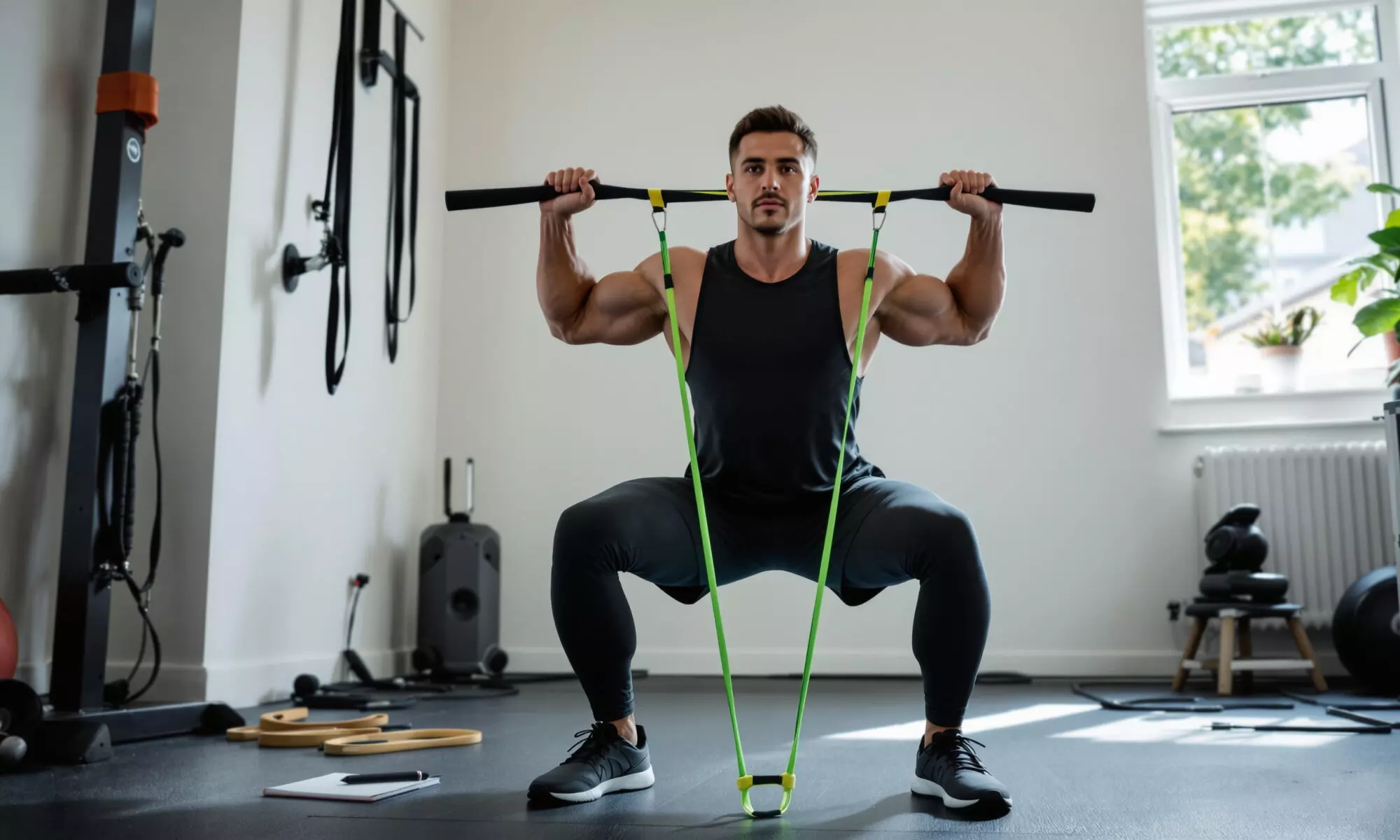
A resistance band workout can build muscle and strength if you perform enough hard sets, train close to failure, and progressively increase the challenge. Bands aren’t inherently inferior to free weights. Their main limitation is measurement: resistance changes as the band stretches. This three-day plan solves that problem with repeatable setups, rep targets, and progression rules you can use at home.
Can a resistance band workout really build muscle?
Yes, provided the working muscle receives enough tension and your sets become progressively harder over time. A 2019 systematic review and meta-analysis by Lopes and colleagues included eight studies and found no statistically significant strength advantage for conventional weights over elastic resistance.
The corrected effect estimates were small: lower-body strength showed a standardized mean difference of −0.11, with a 95% confidence interval from −0.40 to 0.19, while the upper-body result was 0.09, from −0.18 to 0.35. Neither difference was statistically significant. That doesn’t prove bands and weights are identical in every situation, but it does challenge the claim that bands are useful only for warm-ups or rehabilitation.
There are caveats. The 2019 evidence base contained only eight studies, and elastic-training studies often involve short interventions or participants with limited training experience. Direct long-term hypertrophy comparisons in highly trained lifters remain thinner than the broader research on conventional resistance training.
What the research shows is that elastic resistance can produce meaningful strength adaptations. What I’d do in practice is use bands for movements that remain stable and easy to standardize, then take most working sets to roughly one to three repetitions in reserve. The 2026 American College of Sports Medicine position stand supports using proximity-to-failure measures with bands, while stating that momentary muscular failure isn’t required.
Why band tension feels different from a dumbbell
A dumbbell’s mass stays constant. Band tension rises as the material elongates, producing an ascending resistance profile. Laboratory work published in 2025 found strong force–elongation relationships across six TheraBand colors, with R² values of 0.95 to 0.97; stiffer, darker bands generated more force within that product system.
That doesn’t mean color is a universal loading standard. A red band from one manufacturer may produce a different force from another company’s red band. External load also changes with stiffness, starting length, pre-stretch, anchor distance, range of motion, and whether you use one or two bands.
Exercise geometry complicates matters further. An October 2026 narrative review in the Journal of Clinical Medicine explained that joint loading depends on joint angle and moment arms as well as band elongation. More stretch doesn’t automatically mean more useful tension at the target muscle.
Standardize the setup instead of chasing a questionable pound rating. Record the band, your hand or foot position, the anchor height, and your distance from the anchor. A strip of tape on the floor can turn an improvised home movement into a repeatable exercise.
Three-day full-body resistance band workout
Train on three nonconsecutive days, such as Monday, Wednesday, and Friday. Each session covers a squat or lunge, a hip hinge, a push, and a pull. The selected band should let you finish the target range with approximately one to three good repetitions left, acknowledging that the 2022 and 2026 ACSM sources use slightly different definitions of “near failure.”
Perform a brief warm-up and one easier rehearsal set before the first demanding set for each movement pattern. Rest about 90–150 seconds after compound exercises and 60–90 seconds after smaller movements. If you also want a conditioning component, this plan can sit alongside a carefully managed strength-and-cardio schedule.
| Day | Exercise | Starting band level | Sets × reps | Progression trigger |
|---|---|---|---|---|
| Day 1 | Front-foot band squat | Medium loop | 3 × 8–15 | 3 × 15 at 1–2 RIR |
| Day 1 | Standing band row | Medium tube or loop | 3 × 10–15 | 3 × 15 at 1–2 RIR |
| Day 1 | Band-resisted push-up | Light loop | 3 × 6–12 | 3 × 12 at 1–2 RIR |
| Day 1 | Band Romanian deadlift | Heavy loop | 3 × 8–15 | 3 × 15 at 1–2 RIR |
| Day 2 | Reverse lunge | Light or medium loop | 3 × 8–12 each leg | 3 × 12 each leg at 1–2 RIR |
| Day 2 | Half-kneeling overhead press | Light tube or loop | 3 × 8–15 | 3 × 15 at 1–2 RIR |
| Day 2 | Anchored lat pulldown | Medium tube or loop | 3 × 8–15 | 3 × 15 at 1–2 RIR |
| Day 2 | Band good morning | Medium or heavy loop | 2 × 10–20 | 2 × 20 at 1–2 RIR |
| Day 3 | Split squat | Medium loop | 3 × 8–15 each leg | 3 × 15 each leg at 1–2 RIR |
| Day 3 | One-arm anchored row | Medium tube or loop | 3 × 8–15 each arm | 3 × 15 each arm at 1–2 RIR |
| Day 3 | Standing chest press | Medium tube or loop | 3 × 8–15 | 3 × 15 at 1–2 RIR |
| Day 3 | Staggered-stance Romanian deadlift | Medium or heavy loop | 3 × 8–15 each side | 3 × 15 each side at 1–2 RIR |
This resistance band workout supplies six to nine direct weekly sets for the major movement patterns. The 2026 ACSM review reported diminishing strength returns beyond roughly two to three weekly sets per exercise and diminishing hypertrophy returns beyond about 18–20 weekly sets, though those are general resistance-training findings rather than band-specific thresholds.
More isn’t automatically better. If you’re new to structured training, begin with two sets per exercise for the first two weeks. That also aligns with the 2026 ACSM recommendation of at least two sets per exercise while giving your joints and connective tissues time to adjust.
Progress without guessing at band colors
Your logbook should capture more than “blue band.” Write down the manufacturer, band model or marked resistance, stance position, anchor point, repetitions, and estimated repetitions in reserve. For anchored rows, you might record “medium tube, chest-height anchor, toes 180 cm from door, 14 reps, 2 RIR.”
Use double progression: build from the bottom to the top of the prescribed rep range, then increase resistance and return to the lower end. Your options are a stiffer band, two compatible bands in parallel, a longer movement range, or slightly more initial tension. For additional ways to progress with limited equipment, see these progressive overload methods without adding weight.
Tempo is useful, but it isn’t magic. A controlled two- to three-second lowering phase can stop you from bouncing through the easiest portion, yet making every repetition extremely slow usually reduces the load and number of productive reps. Honestly, elaborate tempo prescriptions matter less than stable technique, hard sets, and measurable progression.
When the available band becomes too easy but the next one changes the exercise dramatically, use unilateral versions. A one-arm row or split squat effectively gives each limb more of the available resistance. Beginners who need a broader bodyweight progression can also use the staged approach in this push-up and pull-up plan.
Set up and anchor bands safely
Bands age, abrade, and occasionally fail. Manufacturer guidance in 2026 consistently recommends inspecting the band and anchor before use, avoiding sharp or rough contact points, and choosing an anchor that cannot open or cut the material.
- Check the entire band for cuts, cracks, thinning, discoloration, or damaged stitching before every session.
- Use only attachments designed for the band and confirm that a door anchor sits on the side that makes your pulling direction close the door.
- Return the band to resting length under control; don’t release handles or loops while they remain stretched.
- Follow the product’s extension limit. TRX, for example, said in 2026 not to stretch its Strength Bands beyond twice their resting length, but other manufacturers set different limits.
Avoid looping a band over exposed metal edges, rough brick, or furniture that can move. If you’re assembling a dedicated training area, a stable anchor and clear floor space matter more than collecting every band thickness; our home-gym setup guide covers the wider equipment decisions.
Price isn’t a perfect proxy for durability. As one concrete 2026 reference, Serious Steel listed its 41-inch natural-latex loop bundles at US$42.90 for a three-band set and US$119.90 for six bands. Those 4.5 mm-thick loops provide a current product example, not proof that this brand or price range is superior across the market.
Stop using a damaged band rather than attempting a repair. If you have a latex allergy, an injury, or a condition that affects balance or exercise tolerance, ask a qualified clinician or physiotherapist about suitable materials and exercise selection.
Resistance band workout FAQ
How often should I do a full-body band workout?
Three nonconsecutive sessions per week work well for this plan. Two sessions can still produce progress if you train consistently and keep the working sets challenging.
Do resistance bands build muscle as well as weights?
A 2019 meta-analysis found no significant strength advantage for conventional resistance over elastic resistance across eight studies. Long-term muscle-growth evidence in advanced lifters is less complete, so bands are credible tools rather than proven perfect substitutes for every free-weight exercise.
Should every band set go to failure?
No. The 2026 ACSM position stand says momentary failure isn’t required for adaptation. Most sets can stop roughly one to three repetitions short of failure, though estimating RIR with bands takes practice.
How do I know when to use a stronger band?
Move up when you reach the top of the rep range for every prescribed set with consistent setup, controlled technique, and about one to two repetitions remaining. Record anchor distance and band identity so the comparison is meaningful.
Can I combine bands with dumbbells?
Yes. You can use bands for rows, presses, and accessory work while keeping dumbbells or barbells for exercises that are easier to load precisely. The best arrangement is the one that lets you train hard, progress, and recover without turning setup into a daily puzzle.