

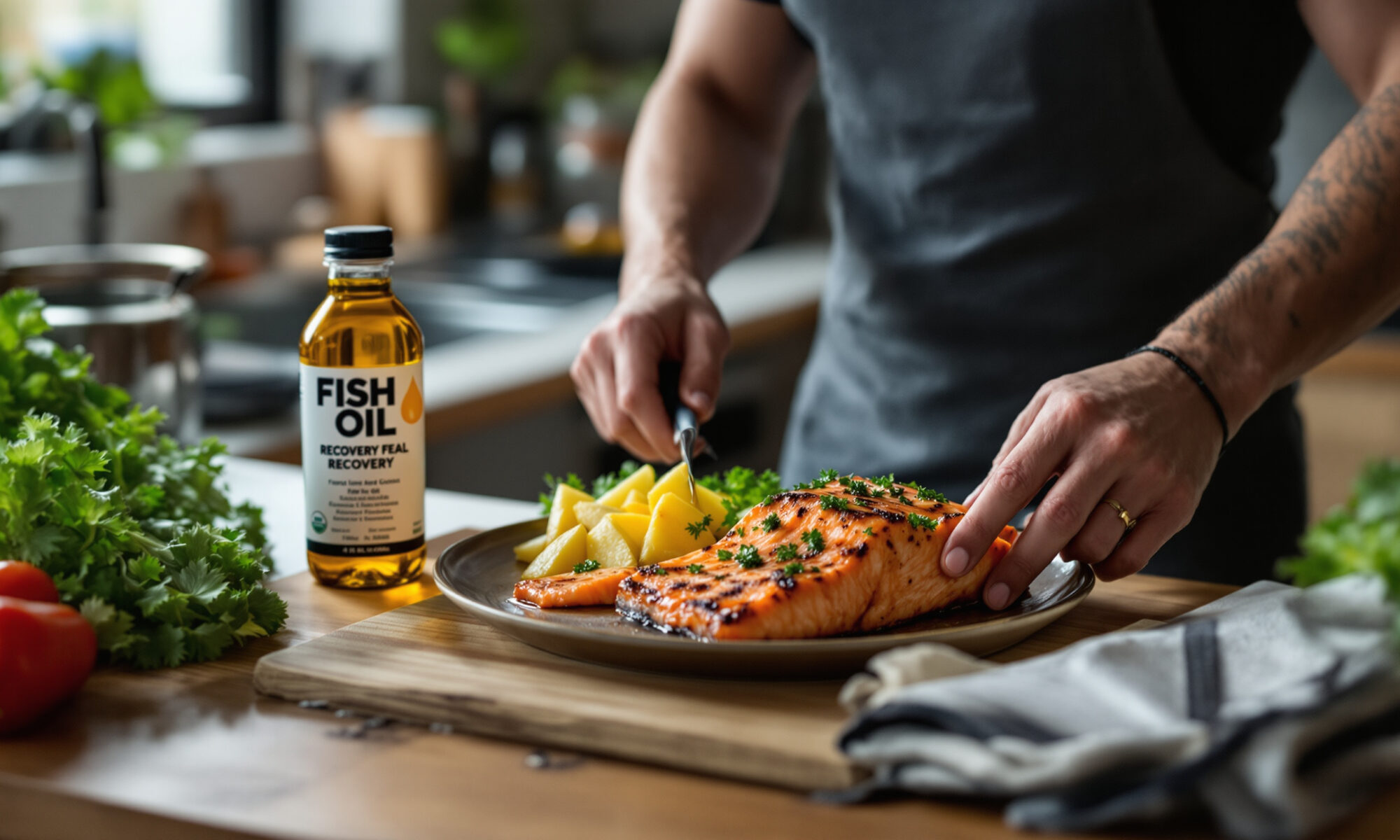
Omega-3 for athletes may modestly reduce soreness and some signs of muscle damage, especially after unfamiliar eccentric exercise. It hasn’t reliably improved strength, endurance, power, or sport performance. Start with one to two seafood servings weekly. If you use a supplement, count EPA plus DHA rather than total fish oil, and don’t exceed 5 g/day from supplements without clinical oversight.
Does omega-3 for athletes actually improve recovery?
The strongest positive signal concerns recovery from deliberately damaging exercise, not everyday performance. A 2025 meta-analysis of nine placebo-controlled trials found reductions in delayed-onset muscle soreness, creatine kinase, and swelling after eccentric exercise. It also reported better strength recovery and range of motion.
The effect sizes were meaningful on paper: Hedges’ g was −0.75 for soreness, −0.40 for creatine kinase, −0.45 for swelling, 0.45 for strength, and 0.93 for range of motion. Yet nine trials remain a narrow evidence base, and the authors couldn’t determine an optimal dose or duration because protocols differed and individual studies had limitations.
That matters because soreness is subjective. A supplement can change how your legs feel without restoring sprint speed, bar velocity, or competitive performance. Reviews published from 2024 through 2026 describe soreness findings as mixed and objective recovery outcomes as less consistent.
The International Society of Sports Nutrition’s 2025 position stand reached a similarly restrained verdict: omega-3 may attenuate indirect markers of muscle damage, but evidence for subjective soreness is equivocal. It also concluded that supplementation doesn’t reduce post-exercise inflammation measures. The common claim that fish oil accelerates recovery by simply “switching off inflammation” is therefore too neat.
A September 2026 randomized trial in older adults adds another caution. Eight weeks of supplementation altered responses to exercise-induced muscle damage but didn’t attenuate the damage. These participants weren’t young competitive athletes, which limits direct transfer, but the result still argues against treating omega-3 as universal recovery insurance.
Studied doses, durations, and outcomes
Trials have often used more EPA and DHA than you’d obtain from an occasional fish meal. They have also loaded participants for several weeks before muscle-damaging exercise, so taking capsules only after a brutal session isn’t the protocol that was studied.
| Study | Participants and duration | Dose tested | Main outcome | Evidence constraint |
|---|---|---|---|---|
| 2024 randomized trial | 30 young men; 7 weeks before downhill running and jumping lunges | 4 g/day EPA+DHA, EPA alone, DHA alone, or placebo | EPA alone and DHA alone reduced soreness at 48 hours; EPA+DHA did not beat placebo statistically | 30 participants; single damaging-exercise protocol |
| 2020 dose trial | 32 resistance-trained college-aged men; about 7.5 weeks | 2, 4, or 6 g/day fish oil | 6 g/day produced the best jump-recovery and soreness findings | 32 men; fish-oil dose was reported rather than a universal EPA+DHA target |
| 2019 immobilization trial | 20 healthy young women; 4 weeks before plus 2 weeks during leg immobilization | 5 g/day omega-3 | Control participants lost 14% muscle volume; omega-3 preserved more muscle | 20 women; immobilization rather than normal training |
| 2017 immobilization trial | 24 healthy adults; 2 weeks of partial arm immobilization | 2.16 g/day EPA+DHA: 1.77 g EPA plus 0.39 g DHA | Nonsignificant trends for lean mass and muscle thickness; only 1 immobilization change was attenuated | 24 adults; mostly null findings |
| 2025 meta-analysis | 9 placebo-controlled eccentric-exercise trials | Multiple protocols; no optimal dose identified | Soreness −0.75; strength 0.45; range of motion 0.93 | 9 heterogeneous trials; dose and duration unresolved |
A 2024 systematic review of 13 controlled trials suggested that at least 2.4 g/day of EPA and DHA for at least 4.5 weeks “appears” effective. That wording deserves respect. Soreness results remained mixed, baseline omega-3 status was generally unmeasured, and the review couldn’t establish that 2.4 g is a minimum effective dose for every athlete.
Honestly, the evidence just isn’t strong enough to declare one recovery dose. A 2026 review cited small samples, heterogeneous exercise protocols, inconsistent compliance reporting, and inadequate data for defining either an optimal dose or an omega-3-index target.
Food first, supplements when the case is specific
As of November 2026, no major public-health authority in the supplied evidence has issued an athlete-specific omega-3 dose. American Heart Association guidance instead provides a practical food benchmark: one to two seafood servings per week, ideally replacing less-healthful foods rather than merely adding calories.
Fatty fish also contributes protein and other nutrients to a recovery meal. For a wider view of meal composition, see our guide to foods that support recovery during frequent training. Capsules shouldn’t distract you from sufficient energy, carbohydrate, protein, and sleep.
A targeted supplement trial makes more sense if you rarely eat seafood, have a restricted diet, or are entering a block with unusually high eccentric stress. Examples include preseason contact practice, downhill-running preparation, or a return-to-training phase supervised by a rehabilitation professional. A 2026 review concluded that routine supplementation can’t yet be recommended for every athlete and favored dietary assessment, followed where appropriate by biomarker assessment.
The immobilization findings are interesting for injured athletes, but they aren’t a treatment protocol. One 2019 study involved only 20 young women and used 5 g/day around two weeks of leg immobilization. Anyone dealing with an injury, surgery, prolonged immobilization, or significant muscle loss should discuss nutrition with a sports dietitian or medical team rather than extrapolate from a small trial.
Read an omega-3 supplement label correctly
The large number on the bottle may be total fish oil, not the active EPA plus DHA dose. Under 2026 U.S. labeling rules, the Supplement Facts panel can declare EPA and DHA per serving. That panel, serving size, and capsule count are what you need for an honest calculation.
- Find the serving size, such as 2 softgels, rather than assuming the figures apply to 1 capsule.
- Add the listed EPA and DHA amounts. For example, 600 mg EPA plus 400 mg DHA equals 1,000 mg, or 1 g, of EPA+DHA per serving.
- Calculate how many servings produce the intended daily amount. Reaching 2.4 g/day with a 1 g serving would require 2.4 servings, which may not match whole-capsule dosing.
- Ignore front-label fish-oil weight when EPA and DHA are listed separately. A 1,000 mg fish-oil capsule isn’t automatically 1,000 mg EPA+DHA.
- Check for product-specific independent testing of identity, EPA/DHA content, and oxidation rather than treating general GMP compliance as proof of each batch.
U.S. good manufacturing practice requirements govern supplement manufacturing, preparation, and storage. They don’t constitute a product-specific test for EPA/DHA concentration or oxidation. A 2019 U.S. retail analysis was reasonably reassuring: most products tested matched their EPA/DHA label declarations and remained within industry or pharmacopeial oxidation limits, including a peroxide-value limit of 5 meq O₂/kg for finished fish-oil products.
That doesn’t mean every bottle is equivalent. Buy only what you’ll use within its stated storage period, follow the manufacturer’s storage directions, and reject capsules with damaged packaging or a clearly rancid odor. Our guide to evaluating fitness supplements explains why label transparency and testing matter more than front-label claims.
Put omega-3 in its proper recovery hierarchy
What the research shows: omega-3 may reduce soreness and preserve selected measures of function after muscle-damaging work. It hasn’t consistently improved normal strength, endurance, explosive power, or sport performance. The 2018 professional-rugby study reporting less soreness and better maintenance of explosive power is promising, but it added omega-3 to a protein-based supplement during preseason, making broad conclusions difficult.
What I’d do in practice: establish adequate food intake, protein distribution, carbohydrate availability, sleep, and sensible workload progression first. Our evidence review of sleep and muscle growth covers a recovery input with much broader relevance, while this guide to organizing recovery around performance helps place supplements in context.
If those basics are stable and your seafood intake is low, omega-3 becomes a reasonable discussion rather than a mandatory purchase. Judge a planned trial by relevant outcomes: soreness at 24 to 72 hours, completion of scheduled training, jump height, sprint time, or bar velocity. Don’t call it effective because you finished a bottle.
Safety sets the ceiling. NIH and FDA consumer guidance says supplemental EPA plus DHA shouldn’t exceed 5 g/day without clinician oversight. High-dose fish oil can have antiplatelet effects, and people using warfarin or similar anticoagulants may require periodic INR monitoring with prescription omega-3 products. Gastrointestinal symptoms and unpleasant taste can also occur.
FAQ about omega-3 for athletes
How much omega-3 should an athlete take daily?
No universal athlete dose was established by November 2026. Trials commonly studied roughly 2.4 to 5 g/day of EPA and DHA for several weeks, but FDA and NIH guidance says not to exceed 5 g/day from supplements without clinician oversight.
How long does omega-3 take to help muscle soreness?
Most relevant studies used loading periods of about 4.5 to 7.5 weeks before damaging exercise. Evidence doesn’t establish that a single post-workout dose reduces delayed-onset muscle soreness.
Is EPA or DHA better for exercise recovery?
A 2024 trial found that 4 g/day of EPA alone or DHA alone reduced soreness at 48 hours, while their combined treatment didn’t statistically outperform placebo. With only 30 young men, that result isn’t enough to declare either fatty acid superior.
Can omega-3 improve athletic performance?
Not reliably. A 2026 athlete review found possible modest benefits for soreness and selected losses of muscle function, but no consistent improvement in strength, endurance, power, or sport performance.
Can you take omega-3 with blood thinners?
High doses can affect platelet activity. If you take warfarin or a similar anticoagulant, discuss omega-3 with your prescriber because INR monitoring or other clinical oversight may be appropriate.