
Wall Pilates vs reformer comes down to three things: resistance, access, and cost. Reformer Pilates gives you adjustable spring resistance and more exercise variety, but it usually means studio classes or an expensive machine. Wall Pilates is cheaper, simpler, and easier to do at home, but it can’t match the load options of a reformer. For most people, wall Pilates wins on convenience; reformer wins on progression and coaching.
Wall Pilates vs reformer: the real difference
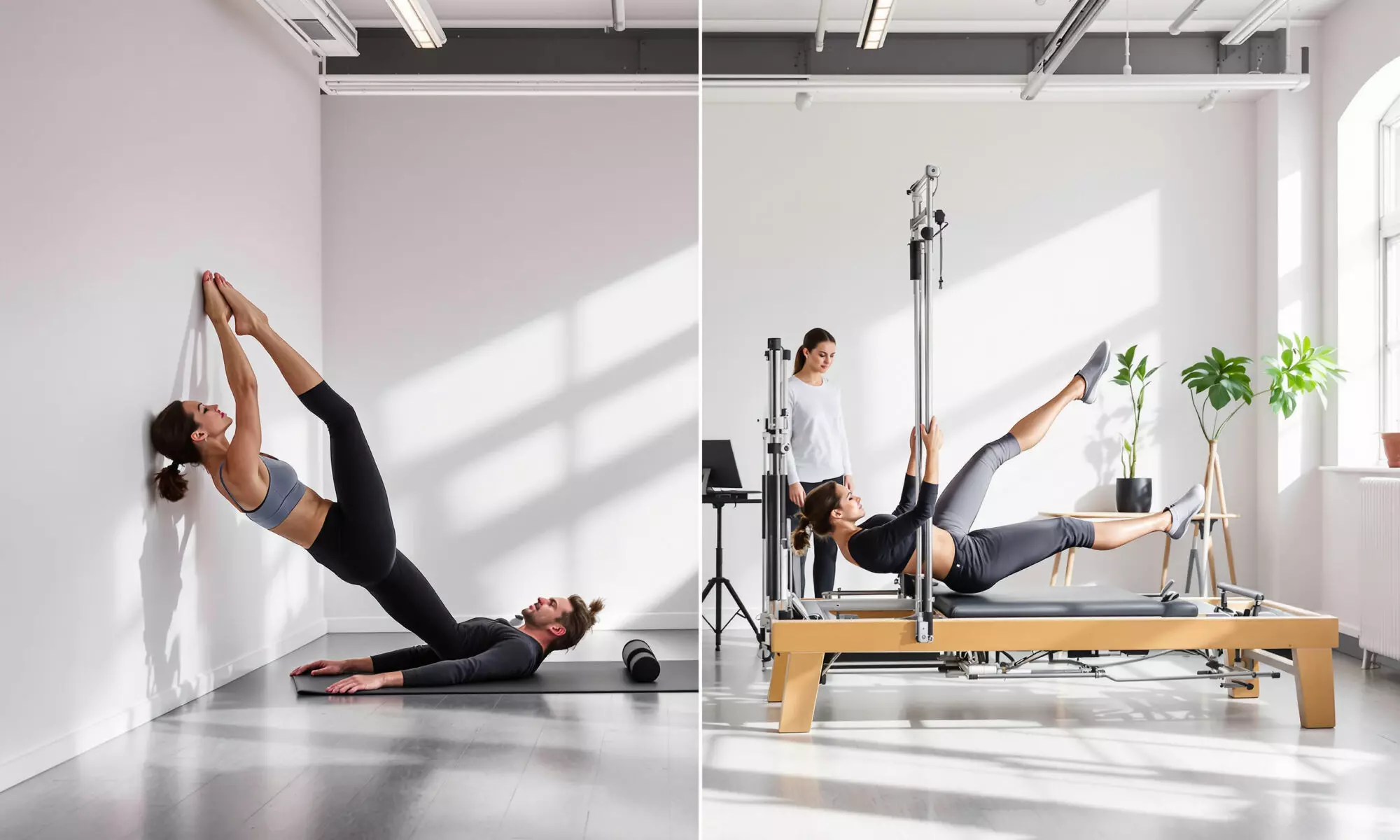
Reformer Pilates uses a spring-loaded sliding carriage as the main resistance tool. That changes the training feel immediately. You can increase or decrease spring tension, work through a moving platform, and perform a wider menu of exercises than you can on a mat with a wall.
Wall Pilates is usually mat-based, with a vertical wall used for support, body-position feedback, and light resistance through leverage. That’s useful, especially for posture, core control, and balance. Still, the wall is a fixed surface. It doesn’t give you the same adjustable loading options as springs and a carriage.
If you train lifters or field athletes, this is the transfer point: reformer work is still low-load compared with barbell or machine strength training, but it offers a more scalable challenge than wall work. Wall Pilates is better thought of as accessible movement practice than progressive resistance training.
Cost and access in 2026
This is where the gap gets huge. A wall, a mat, and some floor space are enough for wall Pilates. Reformer Pilates usually means a studio membership, drop-in classes, or buying a dedicated machine for home.
That matters more in 2026 because reformer Pilates is moving beyond boutique studios. On June 2, 2026, Crunch Fitness announced a national rollout of Crunch Reform Pilates across 20 U.S. locations, and on June 8, 2026, Crunch franchise group The Undefeated Tribe announced reformer additions at select Texas clubs. Those are company releases, not independent audits, but they do show where the market is going: more mainstream gym access, though still not cheap or universally available.
| Category | Wall Pilates | Reformer Pilates |
|---|---|---|
| Primary equipment | Wall + mat | Spring-loaded reformer carriage |
| Typical setting | Home, gym studio, or group mat room | Dedicated studio or reformer-equipped gym |
| 2026 group class cost | $0-$20 if self-guided or mat class | $25-$45 per class |
| 2026 private session cost | $0-$80 depending on instructor format | $90-$150 per session |
| 2026 home equipment cost | $20-$100 for mat and small props | $800-$2,000 entry; $1,200-$3,000 common home range; $3,000-$7,000+ studio grade |
| Typical class size | 1 person at home or larger mat groups | 6-12 people |
| Resistance progression | Body leverage and wall contact | Adjustable springs + moving carriage |
If you’re comparing reformer access at a big-box gym versus a boutique studio, our Crunch membership cost breakdown helps frame where those newer in-gym Pilates offerings may fit financially.
What does the research actually show?
Broadly, Pilates research supports low-impact benefits for core strength, balance, flexibility, and movement confidence. Harvard Health’s 2024-2026 guidance also treats Pilates as a reasonable option for older adults when the program is appropriate and medical issues are accounted for.
But the evidence on wall Pilates specifically is thin. Most strong outcomes research lumps together mat Pilates, apparatus-based Pilates, or mixed protocols rather than testing wall-only programs in healthy adults over long periods. That’s an important caveat that social media usually skips.
There is at least one meaningful comparative signal for reformer work. A 2025 randomized study in people with ankylosing spondylitis found reformer Pilates produced measurable improvements in spinal mobility and disease activity outcomes versus a mat-based Pilates program. Useful, yes. Universal proof that reformer is superior for every healthy person trying to get a stronger trunk or better posture, no.
My read of the evidence is simple: reformer has better tools for progression, which makes superior outcomes plausible when coaching quality is good. Wall Pilates can still be effective for mobility, body awareness, and low-impact training adherence. Honestly, adherence is the part flashy comparisons ignore, and it often matters more than the machine.
Who should pick which option?
Choose wall Pilates if you need low friction. It’s the better fit when budget is tight, your schedule is messy, or you want a short home routine on days when a full training session isn’t happening. If you sit a lot for work, that kind of easy-entry movement can be useful alongside a broader plan; our guide on building a fitness routine with a sedentary job covers that bigger picture.
Go reformer if you want coaching, clearer progression, and more exercise variation without high joint impact. It’s also the better choice if plain mat work feels too easy, too repetitive, or hard to self-correct.
For older adults, deconditioned beginners, or people returning after a layoff, either option can work. The better choice is the one you can perform well and repeat consistently. If you have osteoporosis, uncontrolled pain, recent surgery, dizziness, or a diagnosed spinal condition, get clearance from a qualified clinician before treating Pilates as rehab.
And if your real goal is athletic performance, be honest about the role. Pilates can support trunk control, breathing mechanics, mobility, and movement quality. It is not a substitute for progressive strength work, sprinting, or sport practice.
How to use each one in a real training week
The best use case for most active adults is not choosing one forever. It’s using each tool where it fits. Wall Pilates works well as a short recovery or movement session. Reformer works better as a dedicated low-impact training session with technical feedback.
-
Wall Pilates option: 2-4 sessions per week, 15-25 minutes. Use it on recovery days, work-from-home breaks, or after easy cardio. Focus on controlled spinal articulation, wall squats, glute bridge variations with feet on the wall, dead bug patterns, and side-lying leg work.
-
Reformer option: 1-3 sessions per week, 40-60 minutes. Use it as its own session or after an easy upper-body day. Prioritize footwork, leg presses, bridging, long stretch variations, rows, and anti-rotation core patterns with spring settings that let you move cleanly.
-
Hybrid option: 1 reformer class plus 2 short wall sessions weekly. For a busy person, this is probably the sweet spot: one coached exposure for progression, two cheap sessions for repetition.
If you already do lifting, place Pilates where it won’t dilute your main work. A hard reformer class the day before heavy squats may leave your trunk and hips more fatigued than you expect. That’s the same planning logic behind a sensible deload week: good training is partly load management.
For morning trainees, wall Pilates can also slot neatly into a short wake-up routine before a walk or easy ride. Our piece on a morning movement routine for posture and energy covers why these low-barrier sessions can stick better than elaborate plans.
Common myths that don’t hold up
The first myth is that wall Pilates and reformer Pilates produce the same stimulus if you just work hard enough. They don’t. Effort matters, but equipment changes the resistance profile, exercise selection, and progression options.
The second myth is that reformer automatically means better results. Sometimes it does. Sometimes it just means you paid more for a class that looked sophisticated but wasn’t coached well. The machine helps, but programming and instruction still decide a lot.
The third myth is that Pilates is mainly for flexibility. That’s outdated. Good Pilates sessions can challenge trunk endurance, pelvic control, scapular mechanics, and balance, which is why some runners use similar low-impact work to complement their mobility practice. If that’s your lane, our mobility drills for runners article pairs well with short wall sessions.
What I’d do in practice
If you are new, inconsistent, or skeptical, start with wall Pilates for four weeks. Do 20 minutes three times per week. If you don’t stick to free or cheap movement at home, you probably won’t stick to a paid reformer schedule either.
If you already know you like coached classes and can afford them, try 4-6 reformer sessions before judging the method. One class isn’t enough to separate awkward novelty from actual training effect. You need a little time to learn the machine and feel progression.
For most readers, I’d rank the options like this: wall Pilates for convenience, reformer for progression, hybrid for best overall return. The hybrid only makes sense if the class cost doesn’t crowd out the training that matters more to your goals, like lifting, walking, or sport practice.
FAQ
Is wall Pilates as effective as reformer Pilates?
For convenience and consistency, it can be. For adjustable resistance and exercise variety, no. The best evidence we have suggests reformer may produce stronger functional improvements in some populations, but direct comparisons in healthy adults are limited.
Can wall Pilates build muscle?
A little, especially in deconditioned people, but the ceiling is modest because resistance progression is limited. Think muscular endurance, control, and light strength more than meaningful hypertrophy.
Is reformer Pilates worth the money?
It can be if you value coaching, need low-impact training, and will actually attend. At 2026 prices of roughly $25-$45 per group class or $90-$150 private, it stops being a great deal if it replaces cheaper training you already do well.
Which is better for beginners?
Wall Pilates is easier to start because the cost and setup are minimal. Reformer can also be beginner-friendly, especially in small classes of around 6-12 people where an instructor can correct you well.
Is wall or reformer Pilates better for back pain?
Neither is automatically better. Some people do well with either format, but the right choice depends on the cause of the pain, the exercise selection, and the quality of supervision. Pain with neurological symptoms, trauma, or persistent worsening needs medical evaluation first.