
Progressive overload methods still work when you can’t add plates or dumbbells. The short answer is simple: increase reps, add sets, slow the tempo, shorten rest, increase range of motion, or move to a harder exercise variation. Those six tools raise training stress without changing external load, and they matter most in home training, calisthenics, travel blocks, and any phase where equipment tops out.
Why progressive overload still works without heavier weight
The principle itself is old and well supported. A 2012 review on periodized resistance training described progressive overload as the systematic increase of training stress over time so the body has to adapt, whether that stress comes from load, volume, frequency, or another measurable demand.
That’s the part many lifters miss. More weight is only one overload vector. A 2022 review on progression models found that increasing repetitions or modifying load can lead to comparable muscular adaptations when the total stimulus is equated, although the exact response depends on training status, exercise selection, and how close sets are taken to failure.
For practical home training in 2026, multiple guides from Odin Fitness, Ogamic, BionicGym, MySetPlan, and Sanook Fit all converge on the same non-load levers. That doesn’t make every guide research-grade, but the overlap is telling, and it lines up with what coaches already use in real programming.
The 6 progressive overload methods that matter most
| Method | How to apply | Concrete example |
|---|---|---|
| Repetitions | Add 1-2 reps per set inside a fixed range | Push-ups: 3 x 8 becomes 3 x 10 before changing variation |
| Sets / volume | Add 1 set for the exercise or muscle group | Split squats: 3 sets/week becomes 4 sets/week |
| Tempo / TUT | Slow the eccentric to 3-4 seconds or add a pause | Bodyweight row: 2-0-1 becomes 4-1-1 tempo |
| Rest reduction | Shorten inter-set rest by 15-30 seconds | Air squats: 90 seconds rest becomes 60 seconds |
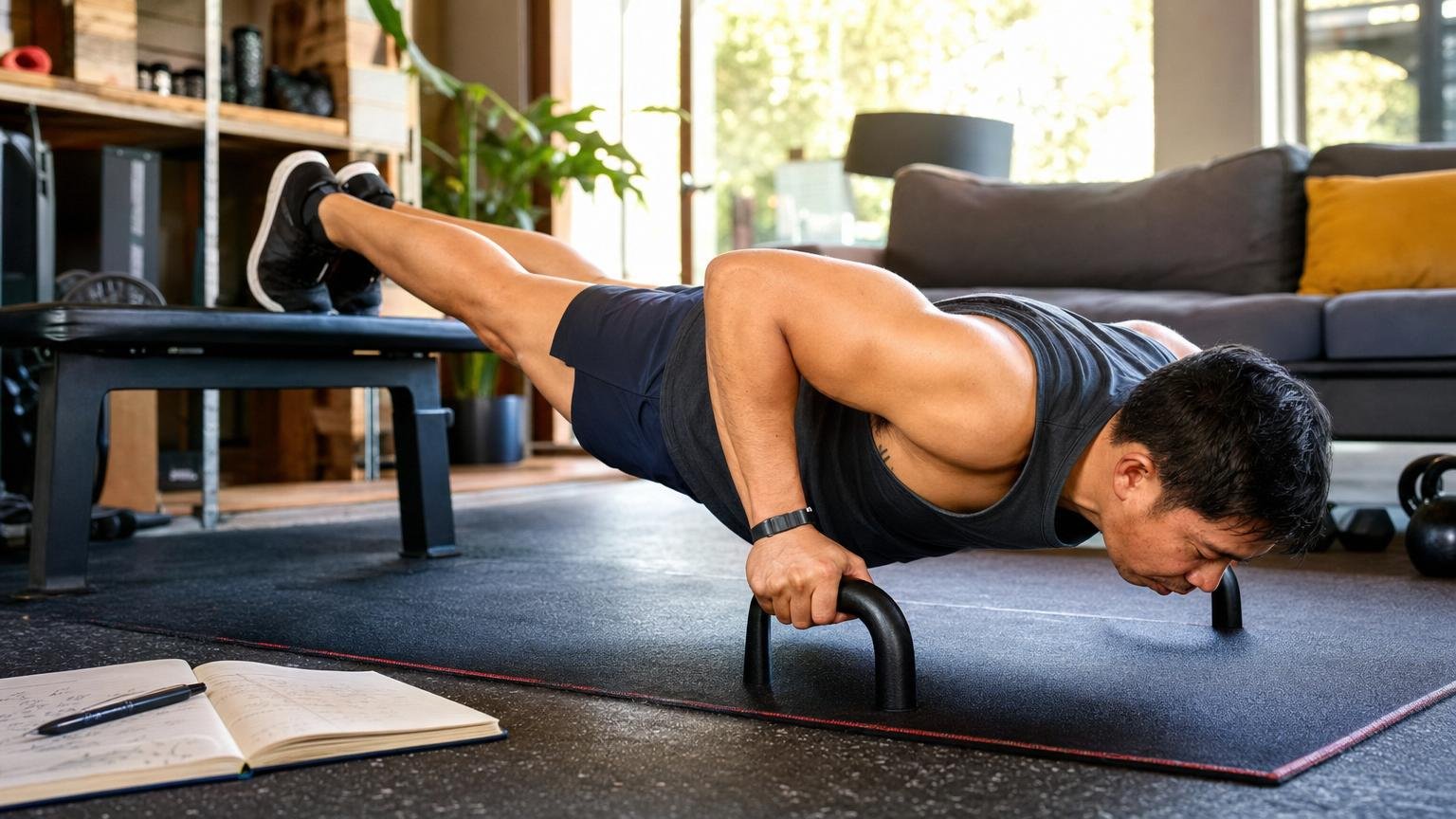
| Range of motion | Use a deeper or longer ROM you can control | Deficit push-up on handles instead of floor push-up |
| Harder variation | Change leverage or stability demands | Push-up to feet-elevated push-up, then archer push-up |
If you want the simplest rule, use one progression vector at a time for two to four weeks. Honestly, this is where a lot of home trainees sabotage themselves. They add reps, cut rest, slow tempo, and switch variations in the same week, then have no idea what actually drove the improvement or the fatigue.
How to use each method without turning training into chaos
Reps are usually the cleanest starting point. Fitloop’s 2026 progression ladder approach is sensible: pick a working range, add one rep when you can, and only change the exercise once you hit the top of that range with solid form. For many bodyweight movements, 6 to 15 reps per set is a useful bracket.
Sets come next. If you’re stalling because one hard set turns into junk after that, adding total weekly volume often works better than chasing endless reps in a single set. A 2022 review on resistance training volume supports the idea that more sets can increase the hypertrophic stimulus, though more isn’t always better once recovery starts slipping.
Tempo is the most abused tool on this list. Harvard Health’s 2025 to 2026 guidance on time under tension makes the basic point well: slowing the lowering phase, often to around 3 to 4 seconds, can raise muscular demand without more load. At the same time, super-slow reps aren’t magic. If the tempo gets so slow that tension drops or you need cartoonishly light effort, the evidence just isn’t there for better results.
Rest reduction is density training. It can be effective, especially for muscular endurance and for making a light implement feel less light, but it’s also the method most likely to blur technique. Shortening rest from 90 seconds to 60, or from 60 to 45, is usually enough. Cutting every movement to 15-second breathless chaos is conditioning disguised as strength work.
Range of motion is underused. Deficit push-ups, deep split squats, and full-length hamstring curls on sliders often create more tension at long muscle lengths, which may help hypertrophy when the position is controlled. This only counts if you own the range, though. Forcing ROM your shoulders, hips, or spine can’t stabilize is not progressive overload. It’s just ugly reps.
Harder variations are the calisthenics staple. Odin Fitness and Ogamic both emphasized leverage progression in 2026, and for good reason: push-up to feet-elevated push-up to archer push-up is a real overload path even with zero added weight. If you need a broader primer on movement progressions, our guide on how to progress from push-ups to pull-ups covers the logic well.
A numbers-based way to progress for 4 weeks
Here’s a simple upper-body example using push-ups when standard reps are getting too easy but you don’t want to add weight yet. Keep two reps in reserve on the first two weeks, then push harder in week three, and back off slightly in week four if fatigue is building.
- Week 1: 3 sets of 10 standard push-ups, 90 seconds rest, 2-0-1 tempo.
- Week 2: 3 sets of 12, same rest and tempo.
- Week 3: 4 sets of 10, 75 seconds rest, same tempo.
- Week 4: 3 sets of 8 feet-elevated push-ups, 90 seconds rest, 3-1-1 tempo.
Notice what’s happening. You are not stacking all six methods at once. Week 2 progresses reps. Week 3 progresses volume and density a little. Week 4 raises difficulty through variation and time under tension while resetting total reps so quality stays high.
This is also more sustainable for people with real schedules. If your recovery is already compromised by poor sleep or a heavy running block, piling on too many stressors is exactly how you end up needing a reset. If that sounds familiar, read our piece on when a deload week actually makes sense.
What the research shows, and what it doesn’t
The strongest evidence base still belongs to resistance training in general, not pure bodyweight progressions isolated one variable at a time. We have decent support for volume progression, solid logic for reps and exercise difficulty, and practical backing for tempo, ROM, and rest manipulation. What we do not have, at least from the sources available here, is a stack of long-term randomized trials comparing each non-weight method head to head in trained calisthenics athletes.
That matters. Tempo-only studies are often short. Density changes can alter both hypertrophy and conditioning demand, which muddies interpretation. Range of motion research is promising in some contexts, especially for long-muscle-length training, but execution quality changes everything. So the honest position is this: these methods are valid, but they’re not interchangeable in every program.
In practice, I’d rank them this way for most people: reps first, exercise variation second, sets third, ROM fourth, tempo fifth, and rest reduction sixth. Why put density last? Because it creates fatigue fast and can make tracking quality harder, especially if you’re also doing conditioning or sport work. If you’re balancing lifting with endurance work, our article on training for a first 10K without losing strength explains that tradeoff well.
The mistakes that stall home training
The big myth is that if you can’t add weight, you can’t keep building muscle or strength. That’s false. A 2022 review supports comparable adaptations when total stimulus is matched, and real-world bodyweight progressions have been building capable athletes for decades.
The catch is that light, easy sets done far from failure usually stop being productive. You need enough effort, enough volume, and a progression plan you can actually log. If your form degrades, your shoulders ache, or your performance drops while body weight is also falling fast, under-recovery may be the issue rather than poor exercise selection. Our breakdown of warning signs that a workout plan is costing you muscle is relevant here.
Another overlooked edge case is older trainees. They can use the same six methods, but aggressive density work and unstable variations tend to be less forgiving than controlled ROM, moderate rep progressions, and added sets. If that applies to you or someone you coach, the exercise priorities in our guide to muscle groups older adults should train are a better anchor than flashy calisthenics progressions. If pain, prior injury, or a medical condition changes exercise tolerance, get an individual plan from a qualified clinician or experienced coach.
FAQ
Can progressive overload methods build muscle without weights?
Yes, if the exercise is hard enough and you keep increasing the stimulus over time. Reps, sets, tempo, ROM, and exercise variation can all work, especially when sets are taken reasonably close to failure.
Which progression method should beginners use first?
Start with reps. It’s easy to track, low risk, and teaches you what a stable movement pattern feels like before you complicate the exercise with tempo changes or harder leverage.
Is slower tempo better for strength gains?
Not automatically. A slower eccentric, often around 3 to 4 seconds, can increase muscular demand, but very slow full reps can reduce the force you produce. It’s a tool, not a superior default.
How often should you change bodyweight exercise variations?
Usually after you own the top of your target rep range for all sets with clean form. For many people, that means every 2 to 6 weeks rather than every workout.
Should you reduce rest times every week?
No. Use rest reduction sparingly, mainly when you want more density or when the exercise is too easy with current equipment. If shorter rest trashes rep quality, you’ve pushed that lever too far.