
Family fitness activities work best when they feel like play, happen regularly, and match each child’s age and motor skill level. For most school-age children, the research-backed target is about 60 minutes of moderate-to-vigorous physical activity per day, but it does not need to happen in one formal workout. Short walks, tag, dancing, playground climbing, scooter rides, and five-minute movement breaks all count, and for many families they work better than organized exercise.
Why family fitness activities matter for children’s health
The public-health case is straightforward. The World Health Organization’s 2020 guidelines recommend at least 180 minutes of physical activity spread through the day for ages 3 to 4, including at least 60 minutes at moderate-to-vigorous intensity, and an average of 60 minutes per day of moderate-to-vigorous activity for ages 5 to 17. Those are useful benchmarks, not moral tests.
What gets lost in generic advice is that movement supports more than body weight. In children, regular activity is linked with better cardiorespiratory fitness, motor competence, bone health, mental well-being, and often better attention and sleep. Screen time is part of the conversation, but the bigger issue is displacement: if tablets and TV push out running, climbing, balancing, throwing, and rough-and-tumble play, kids miss physical skills they actually need.
That fits the broader child-health conversation in 2026 too. Our piece on fitness as a marker of children’s health covers why policymakers keep circling back to daily movement rather than just weight-centric messaging.
Family fitness targets by age
Children do not train like adults. A six-year-old needs opportunities to sprint, stop, hop, throw, and hang. A teenager may be ready for more structured sport, lifting, or conditioning, but still benefits from simple family activity that is low-pressure and repeatable.
| Age group | Research-based movement target | Useful family format | Practical screen note |
|---|---|---|---|
| 1-2 years | 180 minutes/day of varied physical activity (WHO 2020) | 6-12 bouts of 10-20 minutes: walking, dancing, pushing toys, soft-ball play | For age 1: 0 sedentary screen time; for age 2: no more than 60 minutes/day (WHO 2019) |
| 3-4 years | 180 minutes/day total, including 60 minutes/day energetic play (WHO 2020) | 3-6 bouts of 15-30 minutes: tag, obstacle courses, playground climbing, movement songs | No more than 60 minutes/day sedentary screen time (WHO 2019) |
| 5-12 years | Average 60 minutes/day moderate-to-vigorous activity (WHO 2020) | 1-2 active blocks of 20-40 minutes plus walking or outdoor free play | No single universal minute cap; AAP guidance favors consistent household limits and protected sleep in 2026 |
| 13-17 years | Average 60 minutes/day moderate-to-vigorous activity, with vigorous and muscle-bone loading at least 3 days/week (WHO 2020) | 2-4 weekly sport or gym sessions plus walks, bike rides, pick-up games, chores | Focus on displacement, sleep loss, and social-media time rather than chasing one magic number |
Many parents hear those numbers and assume they need a formal 60-minute session. They do not. The data on accumulated activity and the practical success of short movement bouts during the day point the other way: small chunks are often how busy households actually hit the target.
What counts as effective physical activity for kids?
Not all activity does the same job. Easy walking is useful, but kids also need coordination, impact, and variety. Bone and motor development respond especially well to things like jumping, skipping, hopping, climbing, sprinting, and throwing.
That matters because one common myth is that a child who plays one sport twice a week has “covered fitness.” Sometimes yes. Often no. If the rest of the week is mostly sitting, that child may still be short on total movement, free play, and broad motor skill exposure.
Research on motor competence consistently suggests that children who practice a wider menu of movement skills tend to stay more active over time. That does not mean you need to engineer every minute. It means your family week should include locomotion, object control, balance, and some rougher outdoor play when possible.
A simple weekly family fitness plan
For a sustainable routine, keep the structure simple. The goal is not to turn your living room into a youth performance lab. It is to make movement normal, frequent, and low-friction.
- Monday: 20-30 minutes family walk or scooter outing. Add 5 x 20-second races for older kids.
- Tuesday: 15-20 minutes indoor circuit: bear crawls, pillow jumps, balloon volleys, crab walks, hallway shuttle runs.
- Wednesday: Playground day for 30-45 minutes. Climbing, hanging, balancing, and chasing cover a lot of bases.
- Thursday: Dance session for 15-25 minutes using songs kids already know. Keep the bar low and the mood easy.
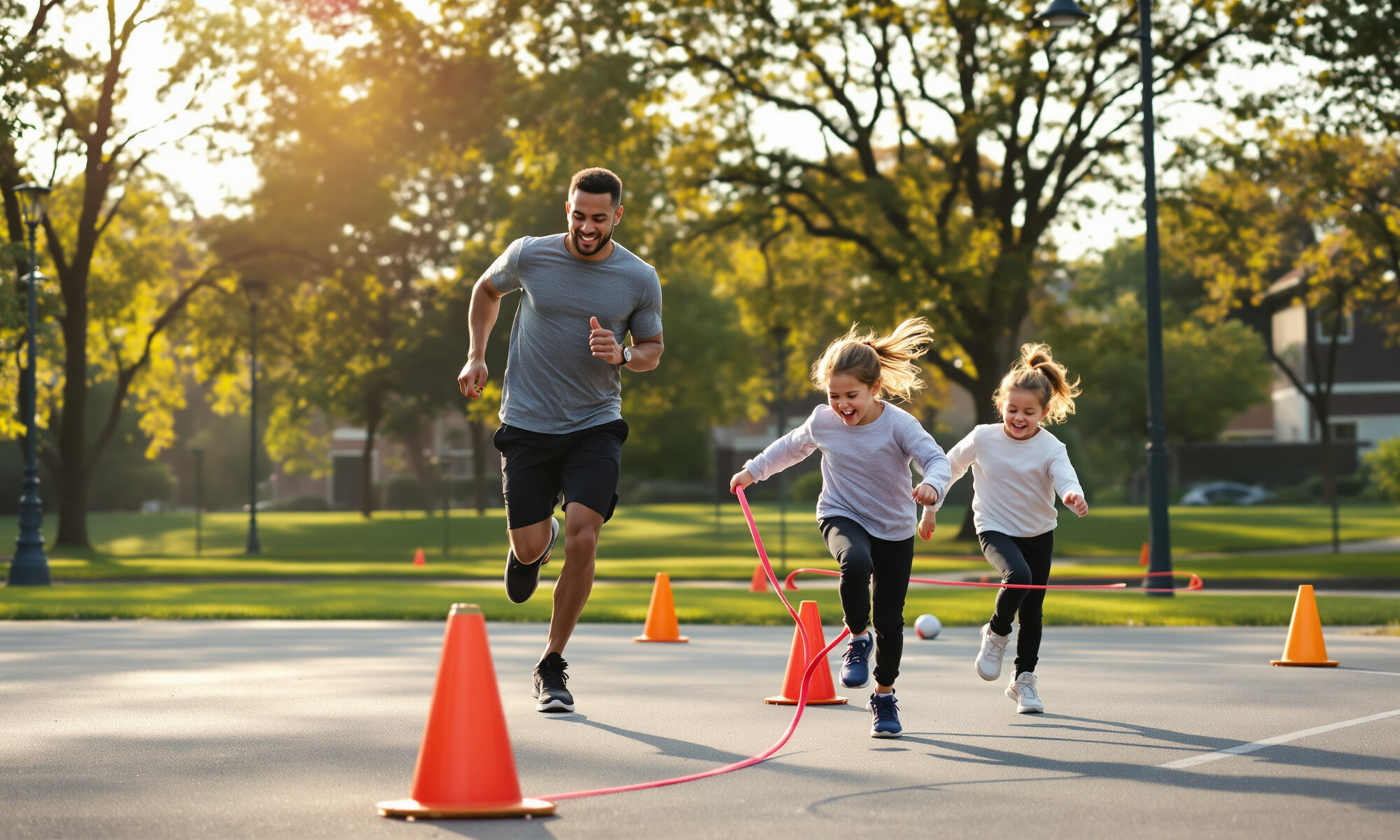
- Friday: Family game night, active version: tag, mini obstacle course, or soft-ball target throws for 20 minutes.
- Weekend: One longer block, 45-90 minutes. Park hike, pool time, bike ride, backyard games, or a community event.
For a healthy school-age child, that template usually gets you close to the public-health target without anyone feeling “put on a program.” If a child has asthma, joint pain, neurodevelopmental differences, or a medical condition that changes exercise tolerance, tailor the plan with a pediatric clinician or pediatric physio rather than forcing the generic template.
Screen time and physical activity: what parents should monitor
Screens are often treated as the main problem, but the evidence is more nuanced. The evidence is less tidy. Screen time itself is not the whole problem; what matters is what it replaces, whether it crowds out sleep, and whether snacking and passivity come along for the ride.
That is why “earn screen time with exercise” systems often backfire. They can make movement feel like a chore and screens feel like the prize. In practice, predictable device boundaries work best when active choices also become the default: walk to the store, put a ball near the door, keep chalk or jump ropes accessible, and build short movement breaks into the after-school window before everyone collapses onto the couch.
Families under stress often need easier wins, not idealized plans. Our piece on using exercise to manage stress and overwhelm applies to parents too, because your own bandwidth usually determines whether the routine lasts.
How to make family fitness easier at home
Kids are not lazy in the abstract. They are responsive to context. If the house has visible balls, cones, scooters, sidewalk chalk, a place to move, and a parent willing to join for 10 minutes, activity rises with surprisingly little persuasion.
Cost matters here. You do not need a child-sized treadmill or a boutique sports package. A ball, chalk, a jump rope, a balloon, painter’s tape for floor lines, and regular park visits will cover a huge amount of useful movement for well under the monthly price of many gym memberships in 2026.
Seasonality counts too. In bad weather, indoor dance breaks, hallway relays, soft object throws, yoga-style animal walks, and simple mobility games work fine. If you need inspiration for holidays and weekends, our guide to family-friendly holiday movement ideas shows how to turn a packed day into a more active one without forcing a “workout.”
Useful family fitness resources
Sometimes families simply need fresh activity ideas. For younger kids, try movement songs for kids, movement nursery rhymes, and kids song lyrics for play when you want structured movement without much setup.
For game ideas, active games for kids can help you rotate activities before boredom sets in. After a high-energy block, calmer transitions matter too, so quiet activities for kids can work as a cooldown rather than a hard stop from chaos to bedtime. If you do use media, keep it intentional, and choose children’s entertainment that supports a planned rhythm instead of endless autoplay.
FAQ
How much exercise do kids actually need each day?
For ages 5 to 17, WHO 2020 guidelines recommend an average of 60 minutes per day of moderate-to-vigorous activity. Younger children need more total movement across the day, but it should look like active play, not formal training.
Are family fitness activities enough if my child already plays sports?
Sometimes, yes. But many kids still benefit from extra free play, walking, climbing, and unstructured movement on non-sport days because one or two weekly practices do not always cover total activity, motor variety, or daily movement habits.
What are the best indoor family fitness activities?
Short dance breaks, balloon games, hallway shuttle runs, animal crawls, pillow obstacle courses, and soft-ball target throws are practical choices. They work because they require little equipment and keep stop-start attention spans engaged.
Should parents limit screen time or just add more exercise?
You usually need both, but in a smart order. Protect sleep, meals, schoolwork, and an active after-school window first, then set predictable device boundaries so movement is not constantly competing with autoplay and notifications.
Can strength training be safe for kids and teens?
Yes, when it is age-appropriate, supervised, and focused on technique rather than maximal loading. For many kids, bodyweight work, medicine-ball throws, climbing, and simple resistance exercises are a better starting point than chasing adult-style lifting numbers.