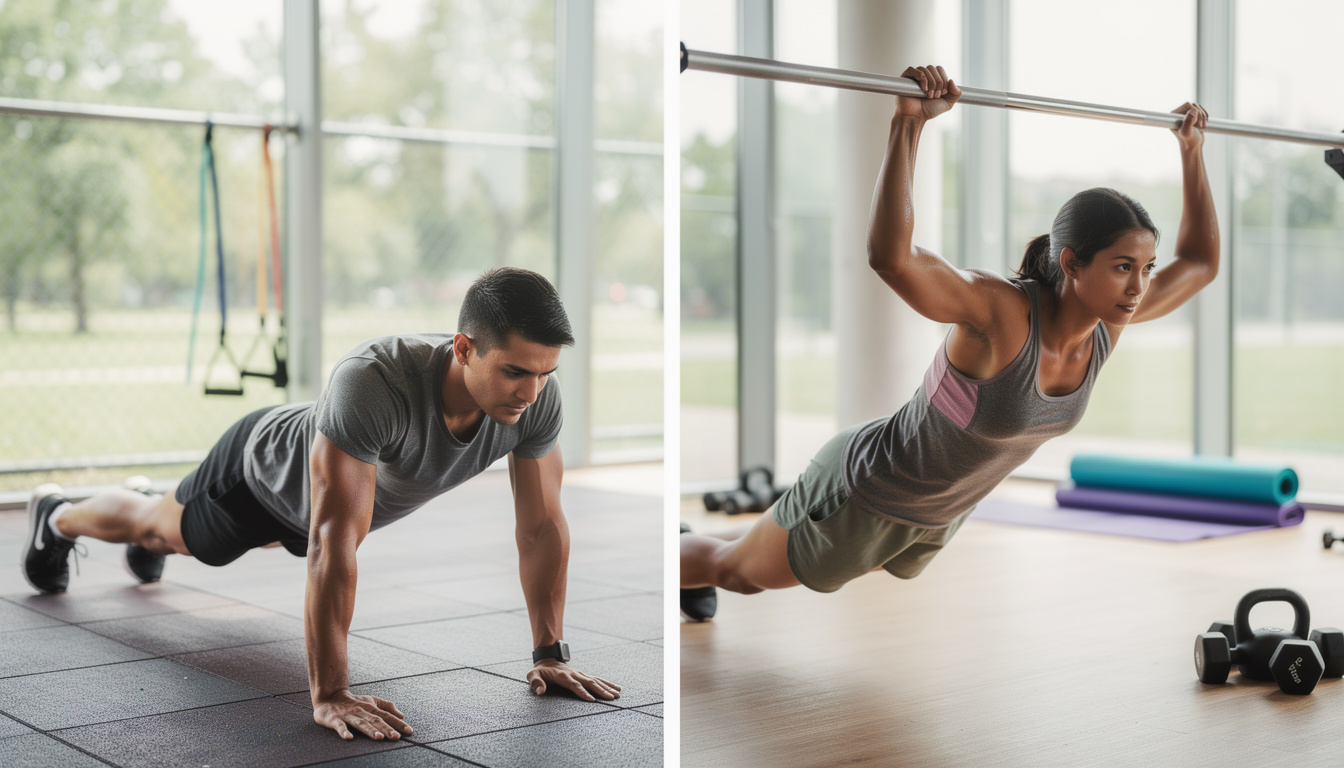
Most beginners do not fail at pull-ups because they lack effort. They fail because they train the wrong pattern. Push-ups build useful pressing strength, trunk stiffness, and shoulder control, but a pull-up asks for scapular depression, vertical pulling strength, grip endurance, and body-position awareness that push-ups do not fully cover. The good news is that push-ups still matter. They can anchor a beginner plan, as long as you add the right pulling progressions and stop treating the first strict rep like a lottery ticket.
This plan takes a practical angle: build the missing pieces in sequence, then test the full movement after enough exposure has made it realistic. You will learn how to assess your starting point, which exercises deserve your time, how to organize two to three weekly sessions, and how to avoid the common mistake of chasing failed reps too early. Fitness Warrior Nation has covered similar progression problems in broader strength training guide pieces, and pull-ups follow the same rule: progress comes faster when the structure is honest.
Why Push-Ups Alone Do Not Build Your First Pull-Up
A push-up teaches you to press your body away from the floor. A pull-up teaches you to pull your body toward a fixed bar. Those patterns share some shoulder stability demands, but the prime movers differ. Push-ups lean hard on the pectorals, triceps, and anterior deltoids. Pull-ups depend more on the latissimus dorsi, biceps, brachialis, lower traps, and forearm flexors.
The trunk also works differently. In a solid push-up, you resist spinal extension while moving horizontally. In a pull-up, you need to hold a hollow or slightly braced body while producing force vertically. If your ribs flare, your shoulders shrug, or your grip fails, the rep dies before your back muscles get enough clean work. That is why beginners often pile up push-ups and still stall at the bar.
There is still a useful carryover. Stronger push-ups can improve general upper-body strength, shoulder tolerance, and midline control. If you pair that with powerful core workouts and dedicated pulling drills, your path gets shorter. The missing link is not motivation. It is specificity.
One simple screen helps. Can you hang from a bar for 20 to 30 seconds with control? Can you perform a slow bodyweight row for 8 to 10 reps? If not, start there before worrying about chin-over-bar glory. Your first job is to own the positions.
A Real Beginner Plan to Progress From Push-Ups to Pull-Ups
The fastest beginner path is rarely the most dramatic one. You need a plan that builds grip, scapular control, rowing strength, and eccentric tolerance, while keeping push-ups in the program for general strength. The American College of Sports Medicine recommends novice resistance training at least 2 days per week for major muscle groups. For pull-up progress, 2 to 3 upper-body sessions weekly is a workable range for most adults.
Start With the Four Skills That Actually Matter
Most beginners should train these patterns before repeated full attempts:
- Dead hangs for grip endurance and shoulder tolerance
- Scapular pull-ups for shoulder blade control
- Inverted rows for foundational pulling strength
- Eccentric pull-ups for strength through the exact path you need
Each one fixes a specific weak link. Dead hangs teach you to support your bodyweight. Scapular pull-ups teach you to move the shoulder blades without bending the elbows too early. Rows let you build enough volume to strengthen the lats and upper back. Eccentrics teach the full pattern under control, which matters because eccentric strength usually exceeds concentric strength.
A 2017 position stand from the National Strength and Conditioning Association noted that eccentric training can improve strength and muscle development efficiently when it is programmed carefully. For beginners, that means low volume, clean reps, and full recovery, not dramatic descents until your elbows start negotiating with you.
The 8-Week Beginner Pull-Up Progression
Use this plan twice per week on nonconsecutive days. Add a third lighter session only if recovery is good and your elbows and shoulders feel normal. Rest about 60 to 90 seconds between easier sets, and 90 to 150 seconds for eccentrics or harder rows.
| Exercise | Weeks 1-2 | Weeks 3-4 | Weeks 5-6 | Weeks 7-8 |
|---|---|---|---|---|
| Push-Ups | 3 x 6-10 | 3 x 8-12 | 3 x 8-12, harder variation if ready | 2-3 x 8-12 |
| Dead Hang | 3 x 15-20 sec | 3 x 20-25 sec | 4 x 20-30 sec | 4 x 25-35 sec |
| Scapular Pull-Up | 3 x 5 | 3 x 6-8 | 3 x 8 | 3 x 8-10 |
| Inverted Row | 3 x 6-8 | 3 x 8-10 | 4 x 8-10 | 4 x 10-12 |
| Eccentric Pull-Up | 2 x 2 reps, 3 sec down | 3 x 2 reps, 4-5 sec down | 3 x 3 reps, 5-6 sec down | 3 x 3 reps, 6-8 sec down |
| Band-Assisted or Feet-Assisted Pull-Up | — | 2 x 4-6 | 3 x 4-6 | 3 x 5-7 |
If you can already do controlled rows and 30-second hangs, begin at weeks 3-4. If you cannot yet hang from a bar, shorten the hang intervals and increase the number of sets. The progression matters more than the calendar. A strict first rep tends to arrive once your eccentrics stay smooth and your assisted reps stop turning into leg-driven theater.
Keep one or two reps in reserve on most sets. On the RPE scale, that is roughly RPE 7 to 8 for the harder work. Beginners improve well without constant failure, and connective tissue usually prefers that arrangement.
Accessory work can help if your setup allows it. Dumbbell rows, cable pulldowns, and hammer curls all reinforce the same chain. If your routine is sparse, start with a few essential strength moves rather than stuffing every machine in the building into one session.
Technique Fixes That Make Your First Rep More Likely
Beginners often miss the same technical details. They hang with shrugged shoulders, kick the legs wildly, pull the elbows behind the body too soon, or crane the neck to chase the bar. None of those errors creates useful leverage. They mostly waste force.
Set your body first. Use a shoulder-width or slightly narrower grip. Start from a controlled hang, then pull the shoulder blades down and slightly back before the elbows drive. Keep your ribs stacked, glutes lightly tight, and legs quiet. A small hollow-body position usually helps.
Your path matters. Pull the elbows toward your sides, not straight behind you. Bring the upper chest toward the bar instead of jutting the chin forward. If you cannot keep this shape on assisted reps, reduce the assistance challenge. Sloppy practice teaches sloppy timing.
Grip deserves more respect here. A weak grip can cap the whole movement, even when your back is getting stronger. Farmers carries and timed hangs help, but simple bar exposure often works. If your hands give out early, do not assume your lats are the problem.
How to Recover, Test Progress, and Avoid Beginner Mistakes
Recovery decides whether your pulling work builds strength or just irritation. Most beginners do well with 48 to 72 hours between harder pulling sessions. Sleep matters more than exotic hacks. Protein matters too. For active adults building strength, the International Society of Sports Nutrition has supported daily protein targets around 1.4 to 2.0 g/kg bodyweight, which is about 0.64 to 0.91 g/lb.
You do not need to test a full pull-up every workout. Try one clean attempt every 2 weeks, after a warm-up and before the harder assistance work. If the rep starts with a strong shoulder set and rises smoothly past the midpoint, you are close. If you stall in the first third, keep building rows and assisted reps. If you reach the top but cannot start cleanly from a dead hang, your scapular initiation still needs work.
Three Mistakes That Slow Down the Process
These errors show up constantly, especially in beginners coming from high-volume push-up routines or random online challenges like a viral military workout trend.
- Testing too often: failed singles create fatigue without enough quality volume
- Using bands that are too strong: heavy assistance changes the strength curve and hides weak positions
- Ignoring shoulder comfort: small elbow or shoulder irritation often grows when eccentrics pile up too fast
If you have a history of shoulder pain, elbow tendinopathy, or neck issues, talk to a physical therapist before adding high-volume pulling work. This pattern has helped many lifters manage weak-link problems, but it is not a substitute for individualized care.
Some readers also ask about weighted vests. They are useful later, once strict bodyweight reps are repeatable, but they are not a beginner solution. Fitness Warrior Nation readers who follow coverage on weighted vest benefits will recognize the same principle: extra load only works after clean mechanics exist.
Quick Takeaways for Your Push-Up to Pull-Up Plan
Train pull-ups indirectly before you chase them directly.
Rows, hangs, scapular pulls, and eccentrics do the heavy lifting.
Keep push-ups, but stop expecting them to solve a vertical pulling problem alone.
Test sparingly, recover well, and let technique stay stricter than your ego.
How many push-ups should I be able to do before trying pull-ups?
There is no exact push-up number that guarantees a pull-up. Many people can do 20 or more push-ups and still lack the grip, lat strength, or scapular control for one strict rep. A better benchmark is a controlled 20- to 30-second hang plus solid bodyweight rows for 8 to 10 reps.
Are chin-ups easier than pull-ups for beginners?
For many beginners, yes. A chin-up uses a supinated grip, which usually gives the biceps a stronger mechanical advantage. If a neutral-grip or chin-up bar is available, that variation can be the best first target before moving to a pronated pull-up.
Can I train pull-ups every day as a beginner?
Daily practice can work only if the volume stays very low and the intensity stays easy, which most beginners misjudge. A safer default is two or three sessions per week, with brief technique exposure on off days only if your elbows, hands, and shoulders feel normal.
Do assisted pull-up machines work as well as bands?
They can work very well because the assistance is stable and easy to adjust in small increments. Machines also let you standardize progression from week to week, while bands often change assistance depending on stretch and body position.