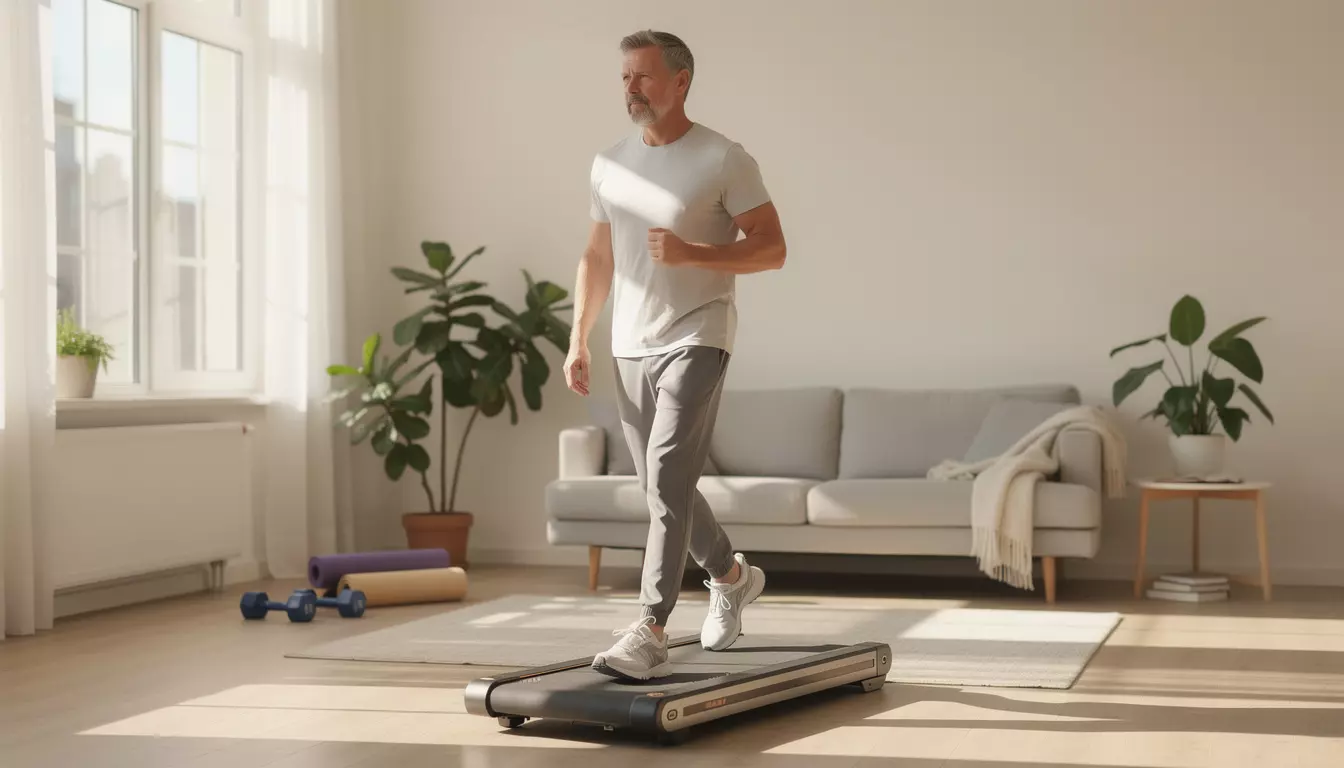
A walking pad solves a modern problem with a modest tool. You spend hours sitting, the weather turns ugly, and a full gym session keeps slipping off the calendar. A compact treadmill will not replace every form of training, but it can turn dead time into useful movement with far less friction than most home fitness gear.
This plan argues for consistency over intensity. A smart walking pad workout plan builds daily activity, supports heart health, and can help with weight control without asking you to train like an endurance athlete in your spare bedroom. You will leave with a practical weekly structure, realistic speed targets, and a clearer sense of how indoor walking fits into a broader routine that actually lasts.
Why a Walking Pad Workout Plan Works
The appeal is simple. Walking is low impact, familiar, and easy to repeat. That matters more than novelty. A routine only helps if you keep doing it through busy workweeks, cold mornings, and the sort of evenings when motivation quietly disappears.
Walking pads also remove common barriers. They need less floor space than most treadmills, and many models slide under a bed or desk. For adults rebuilding activity, that convenience changes the math. At Fitness Warrior Nation, we have seen the same pattern across coverage of sustainable fitness routine strategies: the best plan is often the one with the fewest setup costs.
A walking pad also counts as real walking. You still alternate steps, swing your arms, elevate heart rate, and accumulate activity minutes. Public health guidance from the US Department of Health and Human Services still supports at least 150 minutes of moderate-intensity aerobic activity per week, and indoor walking can contribute to that total just fine.
There is one limit worth stating clearly. A walking pad is excellent for daily movement, but it will not cover every need. You still benefit from strength training, mobility work, and time outdoors when possible. That balance keeps indoor walking useful instead of overrated.
How to Structure a Simple Walking Pad Workout Plan
Most people do better with a routine that feels almost too easy at first. Start there. A 20 to 30 minute session gives you enough time to raise heart rate, build the habit, and finish before the workout starts negotiating with your schedule.
A Beginner Session You Can Repeat
Use this as your default template on most days. Keep the effort at a level where breathing stays controlled and you could still speak in short sentences. On the RPE scale, that is roughly 3 to 5 out of 10.
- Warm-up: 5 minutes at 1.5 to 2.0 mph
- Main walk: 15 to 20 minutes at 2.2 to 3.0 mph
- Cool-down: 5 minutes at 1.5 to 2.0 mph
If the steady pace bores you, add simple intervals. Walk 2 minutes briskly at 2.8 to 3.3 mph, then 2 minutes easier at 2.2 to 2.6 mph. Repeat that pattern for 4 to 5 rounds. You stay below a jog, but the session feels sharper.
The key is restraint. Many beginners turn a good walk into a clumsy shuffle by setting the speed too high. Your faster segments should feel challenging, not unstable. Clean mechanics matter more than bravado on a compact treadmill.
How to Progress Over the First Few Weeks
You do not need dramatic jumps. Small increases work better and reduce the odds that your calves, feet, or lower back start filing complaints. A basic progression can look like this.
| Week | Main Speed Target | Session Length | Goal |
|---|---|---|---|
| Week 1 | 2.0 to 2.5 mph | 20 to 25 minutes | Build comfort and consistency |
| Week 2 | 2.4 to 2.8 mph | 20 to 30 minutes | Raise daily activity with control |
| Week 3+ | 2.6 to 3.2 mph | 25 to 35 minutes | Improve endurance and pace tolerance |
This kind of progression works because it respects adaptation. Your cardiovascular system improves fairly quickly, but tendons and feet usually need more time. That gap explains why a routine can feel easy in your lungs while your body still needs a slower ramp.
If you want a broader activity target, pair your sessions with a daily step goal. Our guide to optimal walking distance for fitness can help you frame distance and time without turning every walk into a numbers contest.
How Long Should You Walk on a Walking Pad Each Day
The right answer depends on your training age, schedule, and tolerance for repetition. More is not always better if it pushes the routine from automatic to annoying. A walking pad works best when it becomes ordinary.
For most beginners, 15 to 25 minutes per day is enough to create momentum. An intermediate user can usually handle 25 to 40 minutes. A more advanced user may go 40 to 60 minutes, especially if some of that time replaces sedentary desk work.
Those ranges are practical, not magical. The public health target remains the bigger frame: 150 to 300 minutes of moderate activity per week. Five 30-minute walks gets you to 150 minutes. That is a strong return for a machine small enough to disappear under a couch in some apartments.
Calorie burn varies more than most app dashboards suggest. Depending on body size and pace, 30 minutes of walking may burn roughly 100 to 260 calories. Use that as a range, not a guarantee. Wearables estimate energy expenditure with error, especially at lower speeds.
If your goal is weight management, focus on total weekly movement and diet quality before chasing one huge session. The dramatic idea of burning 500 calories in a single walk sounds tidy, but in practice it often means a very long session. A 125 lb person walking at 2.5 mph may need roughly 150 minutes to cover 6.25 miles and reach that mark. That is a long date with a belt-driven machine.
How to Make a Walking Pad Better for Fat Loss and Fitness
A walking pad can support fat loss, but the mechanism is plain. It helps you raise total activity and maintain a calorie deficit more comfortably. That is useful because comfort increases adherence, and adherence decides outcomes far more often than any flashy protocol.
Use Intervals and Incline Carefully
If your model includes incline, a modest grade can raise heart rate and energy cost without forcing a jog. Try 1 to 4 percent incline with a brisk pace of 2.7 to 4.0 mph. Keep your torso upright. Do not lean onto the console to fake the workload.
A simple fat-loss oriented session looks like this: warm up for 5 minutes, alternate 3 minutes moderate with 2 minutes brisk for 20 minutes, then cool down for 5 minutes. The pace should stay under control. If you have a history of knee, ankle, or balance issues, talk to a physical therapist before adding incline or longer sessions.
Add Variety Without Ruining the Simplicity
Many people quit because the sessions feel mentally flat before they feel physically hard. Fix that early. Use music, podcasts, or a show you only watch while walking. Save your most disposable streaming series for walking pad duty. Prestige television deserves your couch. Step accumulation usually does not.
You can also rotate formats across the week. One day stays easy. One day uses intervals. One day goes longer at a comfortable pace. If you want more variety beyond walking, our roundups on workouts that keep you engaged and HIIT routines for weight loss can help you add intensity on separate days instead of forcing every tool to do every job.
Some people also carry light dumbbells while walking. Use caution here. Extra load can alter posture and arm swing, and it is usually less useful than simply increasing pace or incline slightly. Start light, keep your grip relaxed, and stop if mechanics get sloppy.
Safety, Form, and Weekly Planning
The boring details matter. Supportive shoes, a clear floor area, and stable posture do more for long-term consistency than a clever interval pattern. Keep your gaze forward, shoulders relaxed, and steps short enough to stay smooth.
If you are older, deconditioned, or returning after injury, start conservatively. A slower pace with more frequent sessions often works better than one ambitious effort that leaves you sore for three days. Our piece on common workout pitfalls for seniors covers several mistakes that apply to walking pads as well, especially around progression and balance.
| Speed | Incline | Estimated Time for 5 Miles |
|---|---|---|
| 2.0 mph | Flat | About 2 hours 30 minutes |
| 2.5 mph | Flat | About 2 hours |
| 2.8 to 3.2 mph | Flat | About 1 hour 35 to 45 minutes |
| 3.0 mph | 2 to 3% incline | About 1 hour 30 to 40 minutes |
| 3.5 mph | Flat or 1 to 2% incline | About 1 hour 25 to 30 minutes |
This table shows why planning matters. Distance targets can become time-heavy fast, especially at beginner speeds. For many adults, a better approach is to anchor the habit to time first, speed second, distance third. That order keeps the routine realistic.
Quick Takeaways
Start with 20 to 30 minutes, not heroic sessions.
Use 1.5 to 3.0 mph as a practical beginner range.
Progress slowly so feet, calves, and joints keep pace with your cardio gains.
Intervals and incline help, but only after you own the basics.
Walking pads work best as part of a wider routine that also includes strength training.
Does a walking pad count toward daily steps?
Yes. Most wearables and phone pedometers count walking pad steps if your arm swing is normal or the device is placed correctly. If you work at a desk while walking and hold the rails or type heavily, your tracker may undercount, so distance shown on the pad can be a useful backup.
Can I lose weight with a walking pad workout plan?
A walking pad can help with weight loss by increasing daily energy expenditure and reducing sedentary time. Results depend more on total weekly movement, food intake, and consistency than on one hard session, and pairing indoor walking with two to three weekly strength sessions usually preserves muscle better during a calorie deficit.
What speed should beginners use on a walking pad?
Most beginners do well between 2.0 and 2.7 mph once they finish a warm-up. If you cannot maintain steady posture or you start drifting backward on the belt, the speed is too high, even if your breathing feels fine.
Is it okay to use a walking pad every day?
Usually, yes, because walking is low impact and easy to recover from. Daily use works best when you vary duration and effort across the week, keep footwear supportive, and watch for early signs of overload such as foot soreness, Achilles tightness, or unusual hip fatigue.