The short answer: a useful Caitlin Clark workout isn’t about copying a celebrity routine. It’s about building the qualities her game demands: lower-body force, trunk stiffness, repeat-sprint conditioning, and enough upper-body strength to keep shooting mechanics stable under fatigue. Public details on her exact programming are limited, so the smart move is to borrow the principles, not pretend you need a WNBA support staff.
What the Caitlin Clark workout is really training
Clark’s defining skill isn’t just “shooting from far away.” Long-range shooting in elite basketball depends on how efficiently force travels from the floor, through the hips and trunk, into the upper body without the whole system leaking energy. That matters even more when the shot comes after deceleration, a change of direction, or contact.
So when people search for a Caitlin Clark workout, the useful answer is this: think legs first, trunk second, conditioning third, and isolated arm work somewhere behind that. Honestly, the popular idea that deep range is mostly a shoulder exercise doesn’t hold up well in real sport.
You see similar transfer in other field and court athletes. Our breakdown of Ilona Maher’s functional power approach gets at the same principle: powerful movement starts with force production and control, not random “sport-specific” gimmicks.
Why lower-body strength matters for deep shooting
A basketball shot starts from the ground. If you can create force quickly through the ankles, knees, and hips, you need less compensatory effort from the shoulders and wrists, especially late in games or during congested schedules. That’s one reason stronger guards often look like they shoot the same ball from 28 feet and 18 feet: the mechanics stay cleaner because the legs are doing more of the work.
Resistance-training research generally finds that maximal strength and power work improve jump performance, sprinting, and force production in basketball athletes. The evidence is better for those broad outputs than for “this lift adds exactly X feet to your range,” because shooting performance is still a skill outcome with huge technical and individual variation.
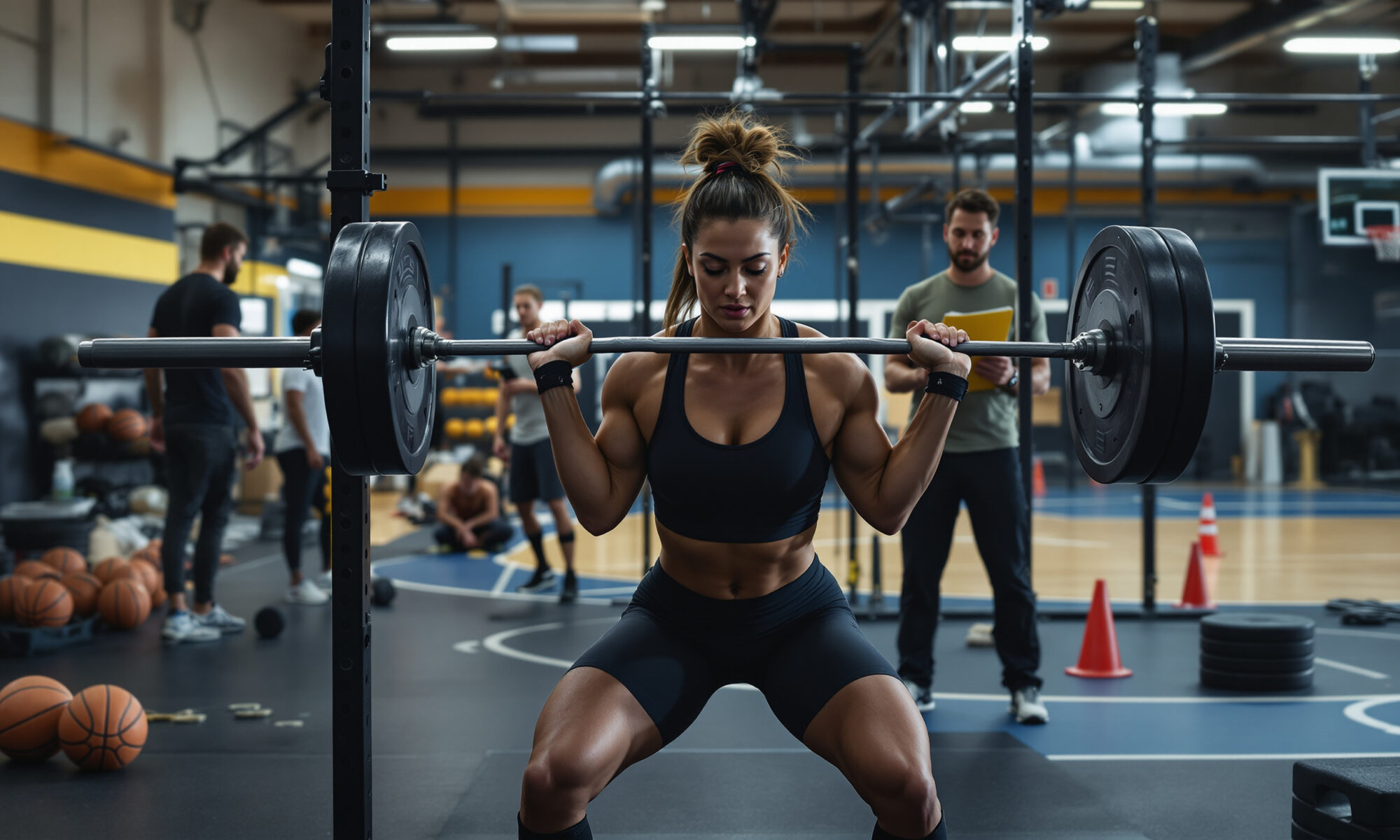
In practice, if you want a Clark-style physical base, I’d prioritize bilateral and split-stance lower-body work over endless machine circuits. Squats, trap-bar deadlifts, rear-foot-elevated split squats, and lateral force work make more sense than chasing a burn with light dumbbells.
A numbers-based template you can actually use
Since a full verified Caitlin Clark workout plan isn’t publicly available, here’s the transferable version: the physical qualities that best match a high-usage perimeter player who needs range, pace, and durability. These are evidence-aligned starting points for healthy lifters and team-sport athletes, not a claim about her private program.
| Training quality | Useful dose | Why it fits long-range basketball | Evidence context |
|---|---|---|---|
| Max strength | 2 sessions weekly, 3-5 sets of 3-6 reps | Improves lower-body force so the shot needs less upper-body compensation | Supported across 2018-2024 basketball and resistance-training literature |
| Power training | 1-2 sessions weekly, 3-5 sets of 2-5 reps or jumps | Helps quick force production after stops, cuts, and pull-ups | Best evidence in jump and sprint outcomes, less direct for shooting |
| Trunk stiffness and rotation control | 2-4 exercises weekly, 2-4 sets of 6-12 reps or 20-40 seconds | Limits energy leaks and helps maintain posture under contact | Mostly indirect sport-transfer evidence, strong biomechanical rationale |
| Repeat-sprint conditioning | 1-2 sessions weekly, 6-12 work bouts of 10-30 seconds | Supports pace, transition play, and skill retention under fatigue | Well supported in team-sport conditioning research from 2019-2024 |
| Tendon and tissue capacity | 2-3 microdoses weekly, 2-3 sets of 8-15 reps | Helps tolerate jumps, decelerations, and schedule density | More practical than glamorous, but very useful over long seasons |
The caveat most articles skip: these doses assume you’re already practicing your sport and sleeping like an adult. Add all of this on top of hard basketball volume, and recovery becomes the limiter fast.
What a practical weekly plan looks like
If you’re a lifter, hooper, or coach trying to apply the Caitlin Clark workout idea, keep the structure simple. Two lifting days and one dedicated conditioning session is enough for most non-pros, especially during a season or while playing pickup two to four times per week.
-
Day 1: Lower-body strength and trunk control. Trap-bar deadlift 4 x 4, rear-foot-elevated split squat 3 x 6 each side, lateral lunge 3 x 6 each side, cable chop or Pallof press 3 x 8-10, calf raises 3 x 12.
-
Day 2: Power and upper-body support. Box jump 4 x 3, goblet squat 3 x 5 fast, push-up or dumbbell bench 3 x 6-8, one-arm row 3 x 8, landmine press 3 x 6 each side, dead bug variation 3 x 8 each side.
-
Day 3: Repeat-sprint conditioning. 8-10 rounds of 15 seconds hard and 45 seconds easy on a bike, court shuttle, or rower, then 10-15 minutes of low-intensity cooldown work.
That won’t make you Caitlin Clark. It will give you a better base for the things her game showcases. For comparison, our look at Aitana Bonmatí’s mix of agility, endurance, and smart recovery shows the same reality in another stop-and-go sport: quality beats volume once technical practice is already high.
The myth to drop: deep range is mostly an arm-strength issue
This is the big one. Recreational players often assume that if they want longer range, they need more delt raises, triceps kickbacks, and high-rep pressing. That can help a little if you’re very weak. Past that point, it’s usually the wrong bottleneck.
What the research and coaching practice suggest is that skill, timing, lower-body force, and trunk coordination matter more than bodybuilding-style shoulder fatigue. A stronger press is fine. But if your shot dies short late in games, the missing piece is often conditioning or leg output, not a magic arm finisher.
You can see a related misunderstanding in recovery tech too. People chase neat dashboards when the real issue is workload tolerance and sleep. Our review of what wearables get right and wrong about recovery scores covers why data can inform training without replacing common sense.
Conditioning that supports skill instead of wrecking it
Elite guards need to handle repeated accelerations, decelerations, and decision-making while keeping shot mechanics intact. That doesn’t mean long, steady cardio is useless. It means the priority should be repeatable high-intensity efforts layered on top of a basic aerobic foundation.
A 2020s team-sport conditioning consensus would usually land on a mix of low-intensity work for recovery and higher-intensity intervals for repeat-sprint ability. For most readers, one interval session and one easy 20-30 minute aerobic session each week is enough. More than that only matters if you’re playing a lot, and if you are, manage it carefully.
That’s also where the elite-vs-normal-person divide matters. A WNBA player can spread stress across skill work, lifting, physio, nutrition support, and planned recovery. You probably can’t. If you’ve got a history of stress injuries, low energy availability, or menstrual disruption, underfueling while adding conditioning is a bad trade; check in with a qualified sports dietitian or clinician before pushing volume.
For another athlete example from a very different body type and role, our piece on Victor Wembanyama’s conditioning model highlights the same transferable idea: the plan has to match movement demands, not social media aesthetics.
What I’d copy, and what I wouldn’t
What the research shows: stronger legs, better power output, and better conditioning tend to support the physical side of basketball skill under fatigue. What I’d do in practice: keep the lifting basic, keep trunk work honest, and don’t let extra gym volume interfere with shooting reps and actual court quality.
What I would not copy from elite-player content is the fantasy that more is always better. Two hard lifts, one honest conditioning session, and consistent skill practice will outperform five flashy workouts for most people with jobs, classes, and normal sleep.
If you want a broader athlete-development example outside basketball, our breakdown of Coco Gauff’s athletic development shows how modern performance is usually built the boring way: force production, movement quality, repeatability, and recovery discipline.
FAQ
What is the Caitlin Clark workout focused on?
The useful version focuses on lower-body strength, trunk stability, repeat-sprint conditioning, and enough upper-body work to support shooting mechanics. It’s less about bodybuilding arms and more about producing force efficiently from the ground up.
Can strength training improve shooting range in basketball?
It can help, especially through better lower-body force and less fatigue-related breakdown, but it won’t replace technical shooting practice. Research supports strength and power gains for athletic performance more clearly than direct shot-range improvements.
How many days per week should I train like this?
For most recreational players, two lifting sessions and one conditioning session per week is enough when combined with basketball. Add more only if your recovery, food intake, and schedule can support it.
Do I need Olympic lifts for a Caitlin Clark-style workout?
No. Jumps, trap-bar work, squats, split squats, and medicine-ball or landmine variations can cover the same power qualities with less coaching demand for many people.
Is upper-body strength irrelevant for long-range shooting?
No, but it’s usually overemphasized. Upper-body strength supports ball control and posture, yet deep range generally depends more on skill, timing, lower-body force, and staying mechanically sound when tired.