NSDR benefits are probably real, but narrower than the hype suggests. The best current evidence, mostly from yoga nidra studies rather than trials labeled “NSDR,” supports short-term improvements in stress, mood, and subjective sleep quality. What it does not yet prove is that NSDR replaces sleep, reliably improves athletic performance, or produces major learning gains on demand. Useful tool? Yes. Magic recovery button? No.
What NSDR actually is
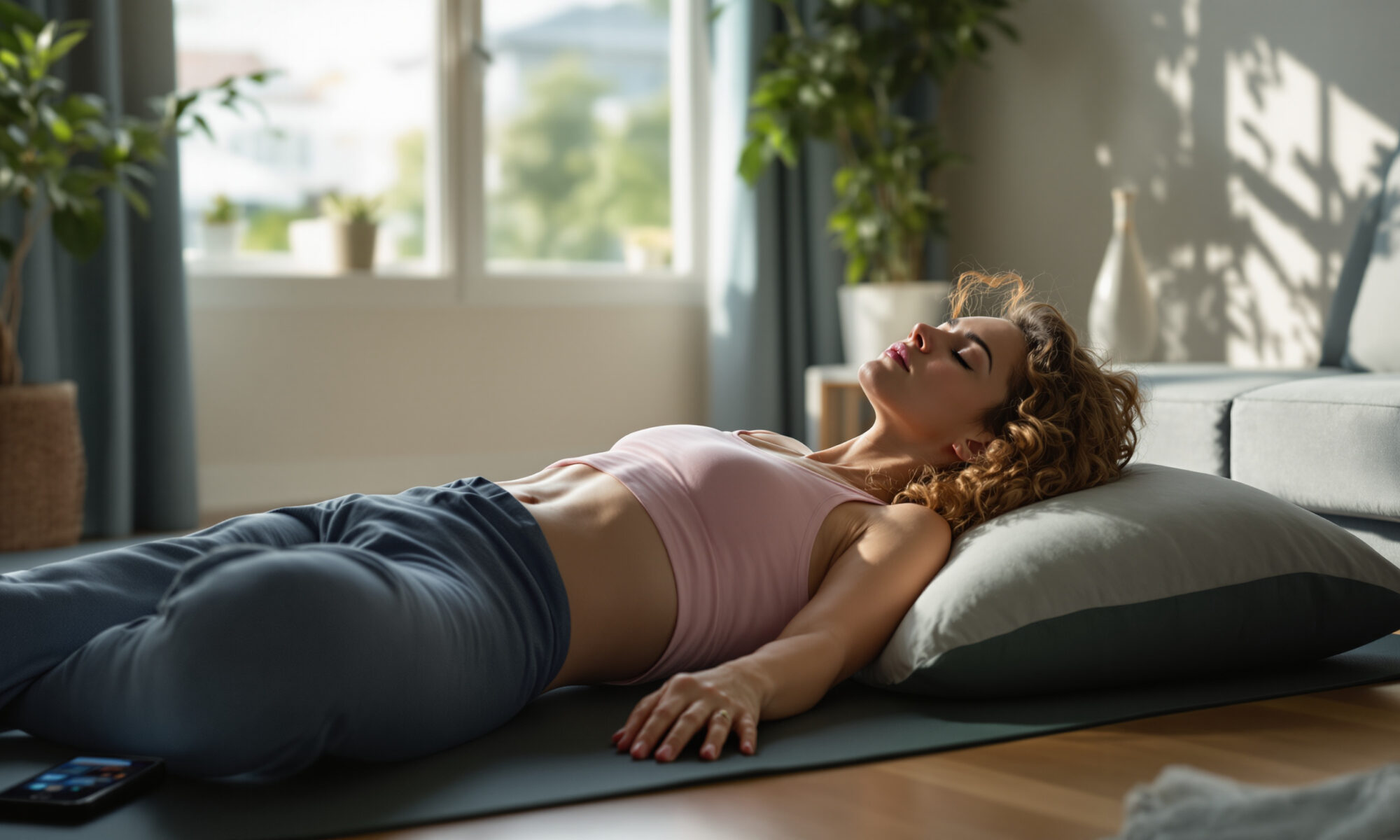
Non-Sleep Deep Rest, or NSDR, is the umbrella term Andrew Huberman popularized for guided practices that aim to downshift arousal without actual sleep. On Huberman Lab pages and podcasts, that usually means a lying-down protocol such as yoga nidra, hypnosis-style relaxation, or other guided body-scan work, often for 10 to 20 minutes and sometimes 30 to 60 minutes when you’re sleep-deprived.
That wording matters because the research base is not really an “NSDR literature.” It’s mostly yoga nidra, guided relaxation, and meditation research. So if you want an honest read on nsdr benefits, you have to translate carefully from those related practices rather than pretend there’s one clean, standardized intervention.
Which NSDR benefits are actually supported?
The strongest support is for mental-state outcomes. A 2026 systematic review and meta-analysis on yoga nidra reported medium-to-large effects on stress, anxiety, and depression across included trials. That sounds impressive, and it may be, but the studies were heterogeneous: different protocols, different populations, different durations, and a lot of self-reported outcomes.
A 2025 randomized controlled trial by Moszeik and colleagues is one of the more useful data points because it was larger than many relaxation studies. It included four groups: 11-minute yoga nidra, 30-minute yoga nidra, an active control, and a waitlist control, with sample sizes of 101, 80, 74, and 107. The intervention groups improved subjective well-being and showed favorable changes in morning cortisol patterns versus controls.
That’s promising. It’s also not the same as proving deeper recovery between hard training sessions, better bar speed, or objectively better nighttime sleep architecture. Most of the literature still leans on perceived stress, mood, and sleep quality questionnaires rather than polysomnography or sport-performance outcomes.
| Protocol or claim | Duration | Sample or source | What the study found | Main limitation |
|---|---|---|---|---|
| Online yoga nidra | 11 minutes | Moszeik et al., 2025, n=101 | Improved subjective well-being and morning cortisol pattern versus control | Subjective outcomes; no polysomnography |
| Online yoga nidra | 30 minutes | Moszeik et al., 2025, n=80 | Improved subjective well-being and morning cortisol pattern versus control | Short-term trial; not athlete-specific |
| Active comparator | Trial arm | Moszeik et al., 2025, n=74 | Used to compare guided rest against another intervention rather than no treatment | Does not answer performance questions |
| Waitlist control | Trial arm | Moszeik et al., 2025, n=107 | Helped show the intervention effect against no immediate treatment | Expectation effects still possible |
| Yoga nidra meta-analysis | Multiple protocols | PubMed-indexed review, 2026 | Medium-to-large effects for stress, anxiety, and depression | Heterogeneous trials and outcome measures |
| EEG and physiology studies | Lab sessions | medRxiv systematic review, 2025 | Reported shifts in EEG oscillations and autonomic markers during yoga nidra | Preprint evidence; mechanism, not performance proof |
Recovery tool or hype for lifters and athletes?
For most trained people, NSDR makes sense as a stress-management and downregulation tool, not as a replacement for sleep, food, or sane programming. If your resting heart rate is up, your mind is buzzing after late training, or you’re fried from work and still need to train, a 10- to 20-minute guided session may help you arrive calmer and less mentally scattered.
That practical use lines up with a broader recovery picture. If you already understand that recovery is a daily health habit, not just a trend, NSDR fits neatly beside sleep hygiene, hydration, and load management. It doesn’t outrank those basics. Honestly, this only matters if you’re already training hard enough for recovery quality to affect output.
The hype starts when people imply NSDR can “make up” for chronic short sleep. It can make a rough day feel more manageable. Research has not shown it can replicate the endocrine, cognitive, and physical recovery functions of a full night of sleep. If sleep timing is the bigger issue, you’ll usually get more from the basics covered in how exercise timing and intensity affect sleep than from adding another guided audio track.
The most repeated claim is that NSDR sharply improves learning and neuroplasticity. Huberman has framed it that way in podcast guidance, usually as a practical recommendation after intense mental work. That idea is plausible and may be grounded in broader relaxation and meditation literature, but there is not one definitive randomized trial showing long-term learning gains from a standardized NSDR protocol in the way social clips sometimes imply.
Another weak spot is objective sleep. Trials often report improved perceived sleep quality, which matters, but perceived sleep and measured sleep are not interchangeable. If you fall asleep faster, feel calmer, and rate your sleep higher, that’s useful. It still doesn’t tell you whether slow-wave sleep, REM duration, or total sleep efficiency materially changed.
Wearable users should be careful here. If your watch gives you a better readiness score after a nap, breathing session, or yoga nidra audio, that may reflect heart-rate variability and a calmer state more than profound recovery. Our breakdown of what wearables get right and wrong about recovery scores is a good antidote to overreading those metrics.
How to test NSDR in your own week
What the research shows: brief guided rest can improve how people feel and may shift stress-related physiology. What I’d do in practice: run NSDR as a two-week experiment, keep the dose simple, and track outcomes that matter to your training instead of chasing mystical language.
- Use a consistent 10- to 20-minute session, 4 to 6 days per week, for 14 days.
- Place it either mid-afternoon, after mentally demanding work, or after training if you struggle to come down at night.
- Keep the format fixed: same audio, same room, same position, lights low, phone on airplane mode.
- Track four numbers daily: sleep quality out of 10, pre-workout energy out of 10, resting heart rate, and whether you completed your planned session.
- Compare the two weeks against your prior two weeks, not against an imaginary perfect baseline.
This matters because recovery interventions often feel profound on day one and disappear into noise by day ten. If your sleep quality rises by even 1 point on a 10-point scale and your training compliance improves, that’s meaningful. If nothing changes, skip the ritual and go for a walk instead. There’s also solid everyday value in daily walking for stress relief, and the evidence base there is broader.
One overlooked edge case: some people get more anxious when asked to “relax” in silence. If guided rest makes you feel trapped with your thoughts, don’t force it. Try a shorter 5- to 8-minute body scan, a seated version, or a low-distraction walk. If you have trauma-related symptoms, panic disorder, or major sleep disruption, it’s smart to check with a qualified clinician rather than treating NSDR as a self-fix.
Best-use scenarios for NSDR
NSDR is most useful when the bottleneck is arousal, not muscle damage. Think travel days, hard cognitive work, late caffeine, pre-competition nerves, or the wired-but-tired feeling after evening training. It may also help shift you out of the constant sitting-and-stimulation loop that makes recovery feel impossible, a pattern related to the hidden cost of sitting all day.
It is less convincing as a fix for poor programming, underfueling, or accumulated sleep debt. If you’re dragging because calories are too low, fluids are off, or training volume is unrealistic, guided rest is a bandage. For example, hydration mistakes alone can make “fatigue” feel like a nervous-system problem when it’s really a basic input problem, which is why common hydration errors that hurt workouts should be cleaned up before you credit any recovery technique.
My view is simple: use NSDR because it’s cheap, low-risk, and easy to trial, not because someone on a podcast made it sound like a neuroscience cheat code. At this point, the evidence just isn’t there for the bigger claims.
FAQ
Does NSDR actually work?
It probably works for some outcomes. The best evidence, mostly from 2025-2026 yoga nidra research, supports reduced stress and better subjective well-being, with some evidence for improved perceived sleep quality.
Can NSDR replace a nap or a full night of sleep?
No good evidence shows that it replaces normal sleep. It may help you feel better on a short-sleep day, but it should be treated as damage control, not a substitute.
How long should an NSDR session be?
Huberman Lab commonly recommends 10 to 20 minutes, with 30 to 60 minutes sometimes suggested when sleep-deprived. For most people, starting at 10 to 15 minutes is more realistic and easier to repeat.
Is NSDR the same as yoga nidra?
Not exactly. NSDR is an umbrella term, while yoga nidra is one specific guided practice that supplies most of the current research base.
What’s the best time to do NSDR?
Mid-afternoon and post-work stress are the most practical slots. If evening sessions make you too alert because of the audio or setup, move them earlier and keep pre-bed routines simpler.