
Lamine Yamal training, at least from what is publicly verifiable in 2024-2026, looks less like a secret workout plan and more like careful body management: controlled load, physio, sleep, and gradual return to team sessions when injuries flare up. That’s exactly what you’d expect for an elite winger who became a first-team and international regular before full physical maturity. The flashy part is his talent. The hard part is protecting it.
What we actually know about Lamine Yamal training
Start with the facts, because this topic attracts a lot of invented detail. Yamal, born in 2006, broke through early for FC Barcelona, won Euro 2024 with Spain, and has had publicly reported periods of hamstring, groin, inguinal, or pubalgia-related management across 2024-2026. Barcelona’s official communications have confirmed stages of injury assessment and partial returns to first-team training, which matters more than any fan-made exercise list.
There is also a widely repeated 2026 report, attributed through media coverage to Spain coach Luis de la Fuente, that Yamal was training up to three hours per day during recovery. That’s plausible in a rehab setting if those hours include physio, treatment, low-intensity field work, mobility, and monitoring rather than three straight hours of hard football conditioning. Still, it’s a single-source media claim, not a published club protocol, so you shouldn’t read it as his normal daily training load.
Just as important is what we don’t know. Barcelona and Spain have not published his exact gym program, weekly sprint counts, sets and reps, or internal medical data. A lot of online posts fill that gap with fake certainty. Honestly, if a site claims to know his exact Thursday lower-body session, treat it as entertainment until proven otherwise.
| Publicly reported Yamal body-management fact | Detail | Year | Source type |
|---|---|---|---|
| Birth year | 2006 | 2006 | Biographical reporting |
| Spain major tournament success | UEFA Euro 2024 winner | 2024 | Match and federation reporting |
| Return to squad work | Part of first-team training session | 2025 | FC Barcelona official report |
| Recovery workload claim | Up to 3 hours per day during recovery | 2026 | Media report quoting Luis de la Fuente |
| World Cup availability | Cleared to play, “ideal condition” reporting before opener | 2026 | Fox Sports media report |
Why a teenage winger needs a different training logic
A player like Yamal isn’t managed like a 27-year-old who’s already fully filled out physically. Late adolescence is awkward territory: performance can be world-class while tissues, recovery capacity, and training history are still catching up. That’s where clubs get conservative, especially with groin, hip, and hamstring issues that can spiral if exposure climbs too fast.
Research on youth athletes and team-sport players generally supports a few boring truths. Sudden spikes in high-speed running, match congestion, poor sleep, and incomplete recovery raise soft-tissue risk; progressive exposure and supervised strength work help. The evidence is never neat enough to predict one player’s injury from one week’s load, but the broad pattern is strong enough that elite clubs build whole departments around it.
For wingers, the tissue problem is obvious. Repeated accelerations, decelerations, sharp cuts, and open-hip striking actions hit the adductors, hip flexors, lower abdominal region, and hamstrings hard. If pubalgia or inguinal discomfort is in the picture, as reported around Yamal, the answer usually isn’t “rest until it disappears” or “just get fitter.” It’s managing force exposure while rebuilding tolerance.
That theme shows up in plenty of other elite-athlete development stories too. Our breakdown of Coco Gauff’s athletic development makes a similar point: teenage stars don’t just need more work, they need the right work at the right dose.
Sleep, physio, and recovery are not the soft stuff
The least glamorous part of Lamine Yamal training may be the most important. Public reporting in 2024 and 2025 repeatedly connected his routine to sleep and recovery priorities, and that lines up with what sports science would expect for a teenager carrying first-team and international demands. The American Academy of Sleep Medicine’s 2016 consensus recommends 8-10 hours per 24 hours for teenagers. For hard-training athletes, living near the top of that range makes more sense than trying to survive on adult-office-worker sleep.
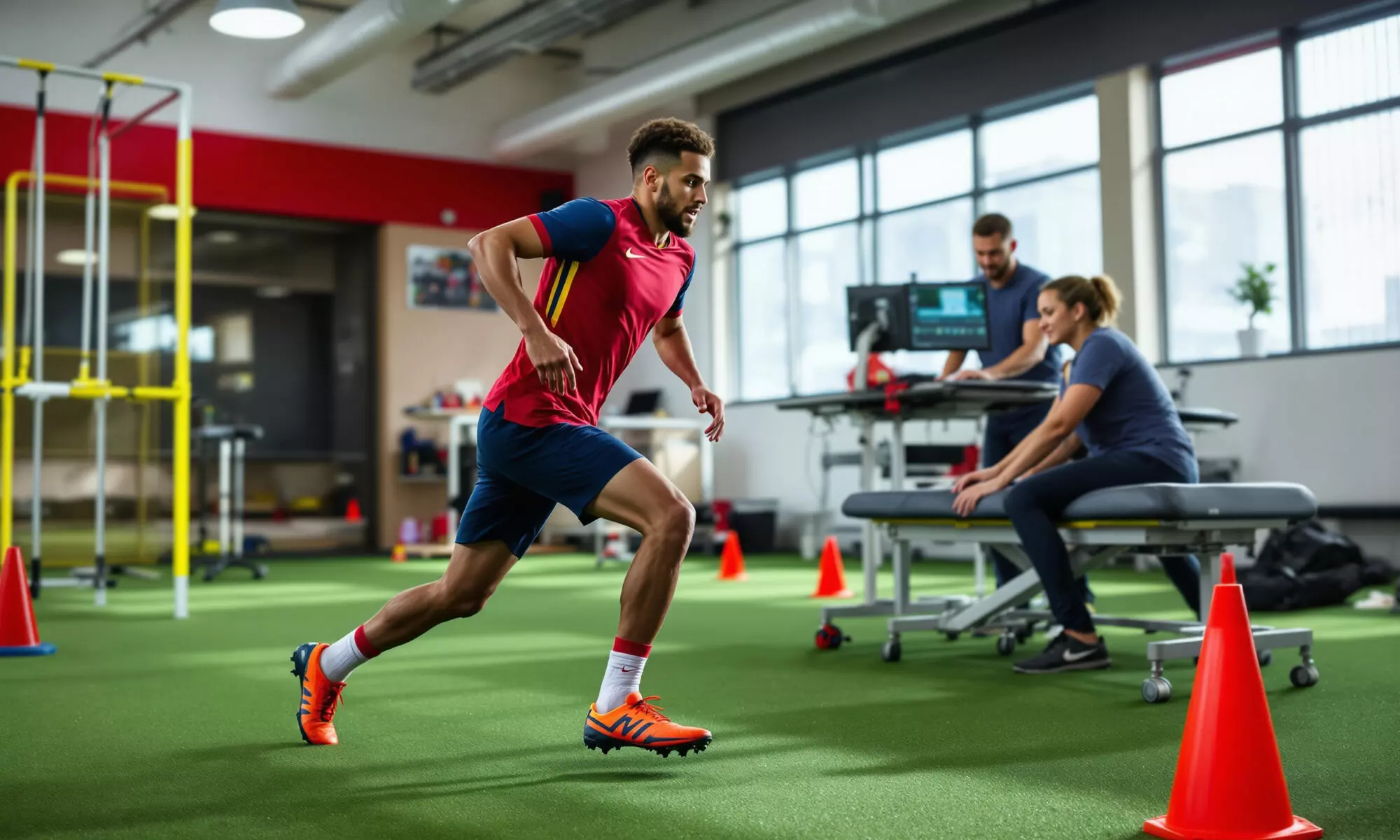
Physio matters here because “recovery” in elite football usually means more than ice baths and massage guns. It can include symptom monitoring, mobility work, trunk and adductor strengthening, field-based reloading, sprint progressions, and decisions about how much team training is useful versus risky on a given day. None of that is flashy, but it is how players stay available.
Wearables can help, but they shouldn’t run the whole process. If you’re interested in what recovery metrics can and can’t tell you, our piece on what wearables get right and wrong about recovery scores is the more honest version than most brand marketing. Data can inform decisions. It cannot replace context.
Yamal’s Ramadan routine, reported by El País in 2025, is also a useful reminder that elite recovery isn’t lived in a lab. Real athletes deal with travel, culture, match calendars, appetite shifts, and sleep disruptions. A plan that works on paper can still fail in real life if those constraints aren’t respected.
What a sensible return-to-play progression probably looks like
We do not have Barcelona’s internal protocol for Yamal. We do, however, know the club publicly reported partial reintegration to training in 2025, and reporting across 2024-2026 describes cautious management. In practice, that usually means the staff is controlling two things at once: symptoms and football exposure.
What the research shows: return-to-play after hamstring or groin issues is safest when loading is progressive, sport-specific, and tied to actual function rather than pain alone. That often means restoring strength and sprint tolerance before full match demands, because a player can feel “fine” in drills and still break down when max-speed actions return.
What I’d do in practice for a young wide player coming off this sort of issue is simple:
- 2-4 days of symptom-calming work and targeted strength, with no max-speed running.
- 3-7 days of controlled field exposure: submax accelerations, change of direction, ball work, and capped volume.
- 2-3 sessions of higher-speed running before full match selection, with at least one exposure near game-speed demands.
- Gradual re-entry to parts of group training before full unrestricted training.
- Minutes management in the first 1-3 matches back, especially if the player is still in adolescence.
That is not a magic formula. It is just the common-sense version of progressive reintegration that most good performance departments use. A similar pattern shows up when you study other high-output athletes, including our look at Aitana Bonmatí’s smart recovery approach, where availability is protected by managing stress, not chasing fatigue for its own sake.
The myth to ignore: more hours always means better development
The popular takeaway from the 2026 reporting is easy to distort: Yamal trains three hours a day, so more is better. No. Rehab time is not the same as productive training time, and a teenager with Barcelona and Spain resources is not following a transferable routine for normal academy kids.
A three-hour recovery block might include assessment, manual therapy, activation, gym work, low-level technical training, video, and cooldown. That’s not remotely the same as telling a 16-year-old winger to stack extra conditioning after team practice. In youth sport, more volume without a clear reason is one of the fastest ways to turn talent into chronic soreness.
Resistance training is the exception people still get wrong. Properly coached strength work for adolescents is generally considered safe and useful, and it likely helps tissue resilience, force production, and movement control. But the public evidence does not show that Yamal is on some mystical football-only program. He almost certainly needs the same basics every explosive athlete needs: sprint exposure, lower-body strength, trunk stiffness, adductor capacity, and enough recovery to adapt.
If you want a parallel from another movement-heavy rotational sport, our piece on Carlos Alcaraz’s speed and rotation demands shows how elite young stars are often built on repeatable physical qualities, not novelty.
What young athletes and parents can actually apply
This is the part most coverage skips. You do not need Barcelona’s staff to use the logic behind Lamine Yamal training. You need restraint, structure, and a willingness to prioritize availability over social-media-worthy grind.
Here are the transferable principles. Keep weekly training changes moderate instead of making huge jumps because one session felt good. Keep 2 strength sessions per week in the schedule during the season, usually 30-45 minutes each, focused on split squats, hinges, calf work, trunk control, and adductor strength. Keep at least 1 exposure to faster running in the week for field-sport athletes, because avoiding speed completely can leave tissues unprepared when matches demand it.
And protect sleep like it matters, because it does. Teenagers balancing school, screens, travel, and sport often dig themselves into recovery holes long before anybody notices. If a young athlete has repeated groin or hamstring pain, unexplained fatigue, menstrual disruption, major weight change, or persistent low mood, that’s when a qualified sports physician or physiotherapist should be in the loop rather than guessing from TikTok clips.
Recovery shouldn’t become superstition, either. A foam roller, cold plunge, or sleep tracker isn’t special by itself. The useful question is whether the athlete is actually adapting and staying available. You see the same idea in endurance sport too, and our analysis of Leon Marchand’s training and recovery discipline gets at why recovery only counts when it supports the work that matters.
FAQ
How much of Lamine Yamal’s training plan is publicly known?
Only a limited amount. Official and credible reporting covers injuries, partial returns to training, recovery emphasis, and coach comments, but not his exact gym program, loads, or week-by-week prescriptions.
Did Lamine Yamal really train three hours a day while injured?
That was reported in 2026 by media quoting Spain coach Luis de la Fuente. It is plausible in a rehab context, but it should not be treated as a verified description of his normal football training day.
Why are groin and hamstring issues such a concern for young footballers?
Because explosive running, cutting, and kicking place repeated stress on those areas, and adolescents are still building training age and tissue tolerance. If return-to-play is rushed, those issues often recur.
What is the most transferable lesson from Lamine Yamal training?
Protect the athlete before you chase extra volume. Sleep, progressive loading, supervised strength work, and cautious return-to-play are more useful than copying a celebrity routine you can’t verify.