
Balance rarely gets top billing in training plans. After 40, that blind spot starts to matter. Small losses in leg strength, reaction time, joint mobility, and sensory processing can quietly change how you walk downstairs, turn quickly, or catch yourself after a missed step. The issue is bigger than falls alone. Balance tracks with mobility, confidence, brain workload, and how well you stay active across the next few decades.
This matters because balance is highly trainable. You do not need exotic tools or long sessions. You need a better framework. Below, you will see what research suggests about stability after 40, how to screen it at home, and which drills actually improve it without turning your week into a rehab project.
Why Balance Training Matters More After 40
Balance is a full-body skill, not a party trick. It depends on muscle force, ankle control, hip stability, vision, inner ear input, and proprioception, which is your sense of where your body is in space. After 40, several of those systems start to lose a bit of sharpness. On their own, the changes may seem minor. Together, they can alter how safely and efficiently you move.
That helps explain why stability often declines before people notice a major problem. You may simply feel less steady on uneven ground or slower while changing direction. In practice, that can reduce activity levels. Then the cycle gets worse. Lower activity weakens the exact systems that protect balance in the first place.
Research supports that broader view. A large observational study from Portugal found that older adults with stronger balance scores also tended to be more active, walk faster, and report better quality of life across physical, emotional, and social domains. Walking speed stood out as a meaningful signal. Faster walkers generally scored better on function and well-being, while lower balance scores clustered with lower activity and more frequent falls.
The takeaway is simple. Balance loss is rarely just about one awkward step. It usually reflects a larger shift in physical capacity.
If you already train for strength, this should sound familiar. Our coverage of strength training for older adults shows the same pattern: movement quality and force production age better when you keep practicing them.
Why Falls Are Only Part of the Story
Fall prevention gets most of the attention for good reason, but it is not the only lens worth using. Better stability often means cleaner foot placement, more confident gait, and less hesitation in daily movement. Those changes affect how often you choose the stairs, how long you keep walking, and how much you trust your body during normal tasks.
A study from the University of Madeira, which followed more than 800 older adults, pointed to leg strength and balance as major drivers of healthy aging. The message was not subtle. Much of the benefit usually credited to “being active” appeared to run through stronger lower-body function and better postural control. If those systems stay capable, independence tends to last longer.
That is one reason balance work belongs next to strength training, not below it. Stability gives force somewhere useful to go.
Why Your Brain Works Harder to Keep You Steady
Balance is partly a brain task. Younger adults often manage posture and foot corrections with more automatic control. With age, the process can require more conscious effort. German research on brain activity during balance tasks found that older adults used more neural resources just to stay steady. In plain English, the same task can cost more attention.
That matters in daily life. If your brain spends more effort on basic stability, distractions become a bigger problem. Carrying groceries while stepping off a curb, turning your head in a crowded store, or walking while talking can become less automatic than they used to be.
The encouraging part is adaptation. In that same line of research, around 12 weeks of balance training improved brain function markers across age groups. Motor-control regions showed stronger coordination, and participants also saw increases in brain-derived neurotrophic factor, or BDNF, a protein linked to neural health and learning. Your nervous system still responds to practice.
That is why balance drills should not be dismissed as “easy” work. They place a real demand on coordination, timing, and attention. Fitness Warrior Nation has covered similar patterns in performance tracking, where small changes in movement quality often show up before bigger declines in output do.
Wearables can help here, though they are not a substitute for screening. If you use one, our review of fitness trackers for outdoor training explains which metrics actually help outside the gym.
How to Check Your Balance at Home
You do not need a clinic to get a useful first read. Two simple screens can flag whether your current stability deserves more attention. Use them near a wall or sturdy chair. If you have a history of falls, dizziness, neuropathy, or inner ear issues, talk to a physical therapist before trying unsupported tests.
| Screen | How to Do It | What It May Suggest |
|---|---|---|
| One-Leg Stand | Stand near support and lift one foot. Try to hold for 10 seconds per side. | Struggling to reach 10 seconds may point to reduced single-leg stability or lower-body control. |
| Timed Up and Go | Sit in a chair, stand up, walk 10 feet, turn, return, and sit down. | A time above 15 seconds can suggest elevated fall risk and slower functional mobility. |
The Timed Up and Go, often called TUG, is widely used in physical therapy and public health settings, including CDC educational materials. It is not a diagnosis. It is a signal. If your score is slowing over time, that is useful information even before a fall happens.
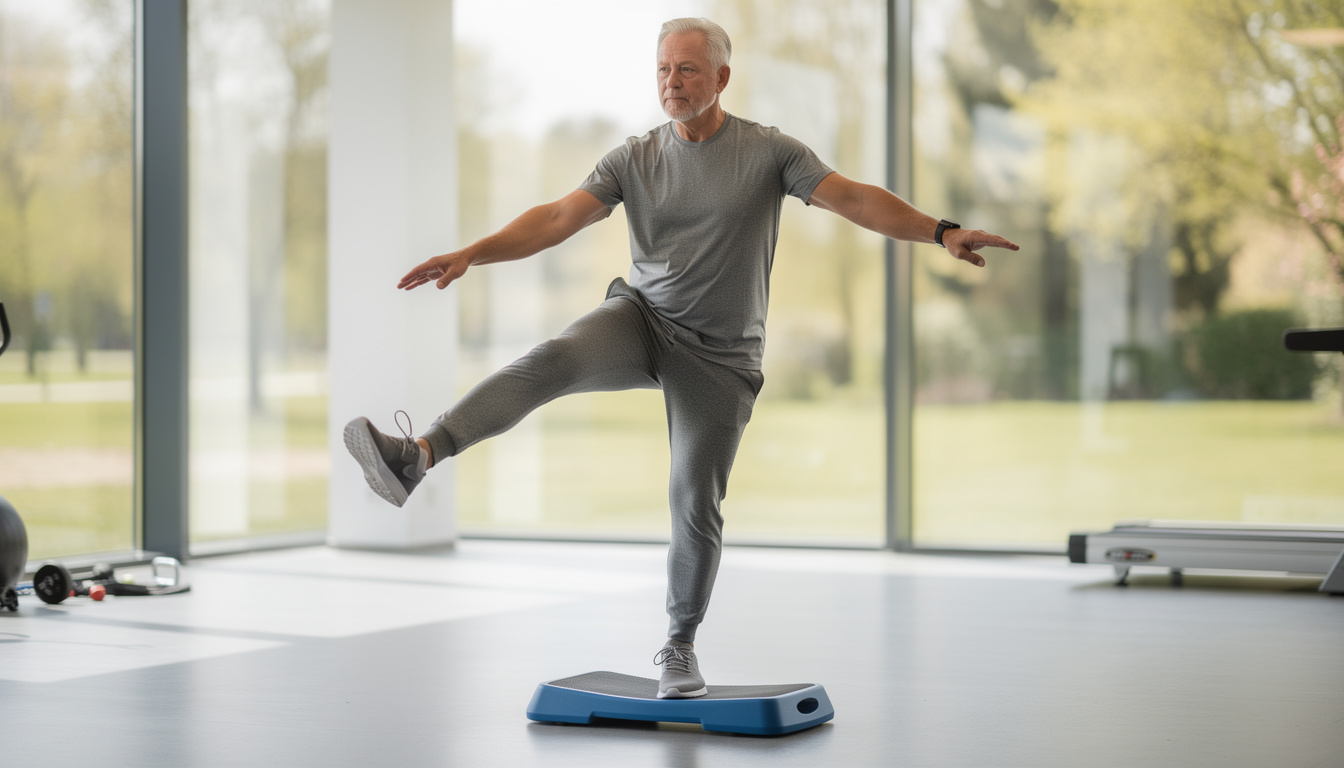
The one-leg stand has its own value because many real-world stumbles happen during single-leg phases of walking. Each step is briefly a balance drill. If one side feels far less stable, that asymmetry deserves attention.
What should you look for besides the clock? Wobbling at the ankle, toe-gripping, torso sway, or a strong side-to-side difference. Those details can guide your training better than a generic goal ever will.
Best Balance Exercises After 40 That Actually Transfer
The best drills are the ones you can repeat consistently and progress safely. Balance improves when you challenge posture, foot control, and lower-body strength together. A few minutes most days often works better than one heroic session every Sunday.
- Heel-to-toe walks: Walk in a straight line with the heel of one foot touching the toes of the other. This builds coordination and midline control.
- Chair squats: Stand up and sit down slowly from a chair for 5 to 10 reps. You train leg strength and upright control at the same time.
- Single-leg stands: Hold near support, then progress by reducing hand contact or turning your head slowly.
- Backward or sideways walking: Short, careful sets challenge motor control in directions daily life often neglects.
- Tai chi or yoga: Both improve posture, body awareness, and controlled weight shifts.
- Seated alphabet feet: Trace letters with your foot to build ankle control, which matters more than most people realize.
Why these moves work is straightforward. They target the areas that usually weaken first: ankles, hips, core tension, and rapid corrective strength. A strong deadlift alone does not guarantee that your body can recover from a small trip. You also need timing and directional control.
Progression matters. Start with support nearby. Then narrow your base, slow the movement, close one hand off the chair, or add a head turn. You can also combine strength and stability in the same session. Our guide to strength training for seniors explains why lower-body basics remain central long after beginner status fades.
How to Fit Balance Work Into a Normal Week
You do not need a separate balance day. Add short sets to what you already do. Try one-leg stands while brushing your teeth, heel-to-toe walks during warm-ups, or chair squats between meetings. The practical goal is frequency, not novelty.
A simple structure works well: 5 to 10 minutes, three to five days per week. Pair one static drill with one moving drill and one strength pattern. For example, do single-leg holds, backward walking, and chair squats. That combination trains control, coordination, and force production in one block.
If you lift, give extra attention to the muscle groups that stabilize the hips and ankles. Our breakdown of key muscle groups for older adults is useful here because weak links are often smaller stabilizers, not just prime movers.
Consistency beats complexity. The body learns through repetition, and the nervous system likes regular reminders.
Bottom Line
Balance after 40 is a health marker, not a side quest.
It reflects strength, coordination, gait, and brain efficiency.
Simple home screens can catch decline early.
Short, repeatable drills usually beat elaborate routines.
The sooner you train it, the longer movement stays easy.
How often should I do balance training after 40?
A practical target is 5 to 10 minutes, three to five times per week. Daily practice can work well because balance training creates little muscle damage, though you should still stop if dizziness, pain, or unusual instability shows up.
Can strength training alone improve balance?
It helps, but it usually does not cover everything. Heavy lifting builds force, while balance practice improves foot placement, postural reactions, and sensory integration, which become more important on stairs, uneven ground, and quick turns.
What is a normal one-leg stand time for adults over 40?
Ten seconds is a useful basic benchmark for a home check, especially if you compare both sides. Some clinical norms are higher and vary by age bracket, but a clear left-right gap can matter as much as the raw number.
Is poor balance always caused by aging?
No. Medication effects, vision changes, inner ear problems, neuropathy, sleep loss, and recent inactivity can all contribute. If your balance has changed quickly or you also notice numbness, vertigo, or repeated stumbles, a medical evaluation is a smart next step.