Knee pain changes how you train, but it does not force you into inactivity. The better question is which movements keep your fitness moving forward without piling stress onto an already irritated joint. A smart low-impact plan does not avoid effort. It redirects it. You shift load toward the hips, glutes, hamstrings, and cardiovascular system while trimming the compressive and shear forces that often flare up the knee during running, jumping, deep flexion, or sloppy strength work.
This approach matters because rest alone rarely builds resilience. Most people need a program that improves strength, aerobic capacity, and daily function at the same time. In practice, that means controlled ranges of motion, predictable progressions, and exercise choices that respect pain signals without making the knee the center of the universe. At Fitness Warrior Nation, we have covered how consistency usually beats complexity, and that logic fits knee-friendly training better than almost any other category.
The Best Low-Impact Workout Plan for Knee Pain Starts With Load Management
Most knee pain is not solved by a single magic exercise. It responds to better load management. The knee sits between the hip and the ankle, so bad mechanics above or below it often raise stress where you feel it most.
That is why a useful plan starts with three filters. First, pain during training should stay mild and stable. Many physical therapy frameworks use a 0 to 10 pain scale, and pain that stays around 0 to 3 out of 10 during exercise and settles within 24 hours is often considered acceptable for graded loading. If you have swelling, locking, giving way, or a recent injury, talk to a physical therapist before you train through symptoms.
The second filter is exercise selection. Cycling, rowing, swimming, walking on flat ground, and controlled strength work usually let you train around knee pain more easily than plyometrics or hard downhill running. The third filter is progression. The ACSM and the US Department of Health and Human Services still support a baseline target of 150 minutes of moderate aerobic activity per week, plus muscle-strengthening work at least two days per week. You do not need to hit that number on day one, but it gives the plan a destination.
If you are rebuilding a routine, the same principles from beginner workout tips apply here: keep the menu small, repeat key movements, and progress one variable at a time. Your knee usually prefers predictability over novelty. That is the first useful rule.
What “Low-Impact” Should Mean for a Sore Knee
Low-impact does not just mean “easy.” It means reduced landing forces and lower irritation potential. A hard bike interval can be low-impact. A bodyweight jump circuit can be high-impact even if it looks simple.
For many people, the biggest triggers are rapid direction changes, deep loaded knee bend, or too much volume too soon. Patellofemoral pain often reacts to stair-heavy sessions, steep descents, and repeated deep flexion. Osteoarthritis can also flare with abrupt spikes in volume, though regular exercise is strongly recommended by major guidelines because it improves pain and function over time.
A 2022 clinical practice guideline from the American Physical Therapy Association supported exercise therapy as a core treatment for knee osteoarthritis. The useful takeaway for you is straightforward: motion is usually part of the answer, but the dose has to fit the joint you brought to the gym that day. That distinction separates productive training from random movement.
A Weekly Low-Impact Workout Plan That Builds Strength and Cardio
The best plan balances three jobs: strengthen tissue, raise work capacity, and avoid pain spikes that derail the next session. Four training days per week works well for many adults because it leaves room for walking and recovery.
Here is a practical structure. If you only have three days, combine one cardio day with one strength day and keep the exercise order the same.
| Day | Session | Main Focus | Suggested Dose |
|---|---|---|---|
| Monday | Lower-Body Strength | Glutes, hamstrings, controlled knee loading | 35-45 minutes |
| Tuesday | Low-Impact Cardio | Aerobic base | 25-40 minutes at RPE 4-6 |
| Thursday | Total-Body Strength | Hip stability, core, upper body | 35-45 minutes |
| Saturday | Low-Impact Intervals or Long Easy Session | Cardio tolerance | 20-30 minutes intervals or 40-50 minutes easy |
This plan works because it avoids stacking knee-heavy days. It also gives the joint time to settle between exposures. If your symptoms rise after the Monday session, trim range of motion or reduce total sets before cutting movement entirely.
Day 1: Lower-Body Strength Without Beating Up the Joint
Use exercises that train the legs while limiting irritation. Controlled tempo helps. So does using a box, bench, TRX, or rail support to keep positions honest.
- Box squat to a comfortable depth: 3 sets of 6-10 reps
- Romanian deadlift: 3 sets of 8-10 reps
- Low step-up: 2-3 sets of 6-8 reps per leg
- Glute bridge or hip thrust: 3 sets of 10-15 reps
- Standing calf raise: 2-3 sets of 12-15 reps
- Side plank: 2-3 sets of 20-30 seconds per side
The key choice here is keeping the shin angle and knee bend manageable. A lower box squat and a short step height often feel far better than free squats or lunges. That is not a downgrade. It is targeted loading with less noise.
If home training is your default, a few pieces of useful workout gear can make these modifications easier. A miniband, an adjustable bench, and a stable step platform solve more problems than expensive gadgets. Convenience shapes compliance, and compliance shapes outcomes.
Day 2 and Day 4: Cardio That Improves Fitness Without Repeated Impact
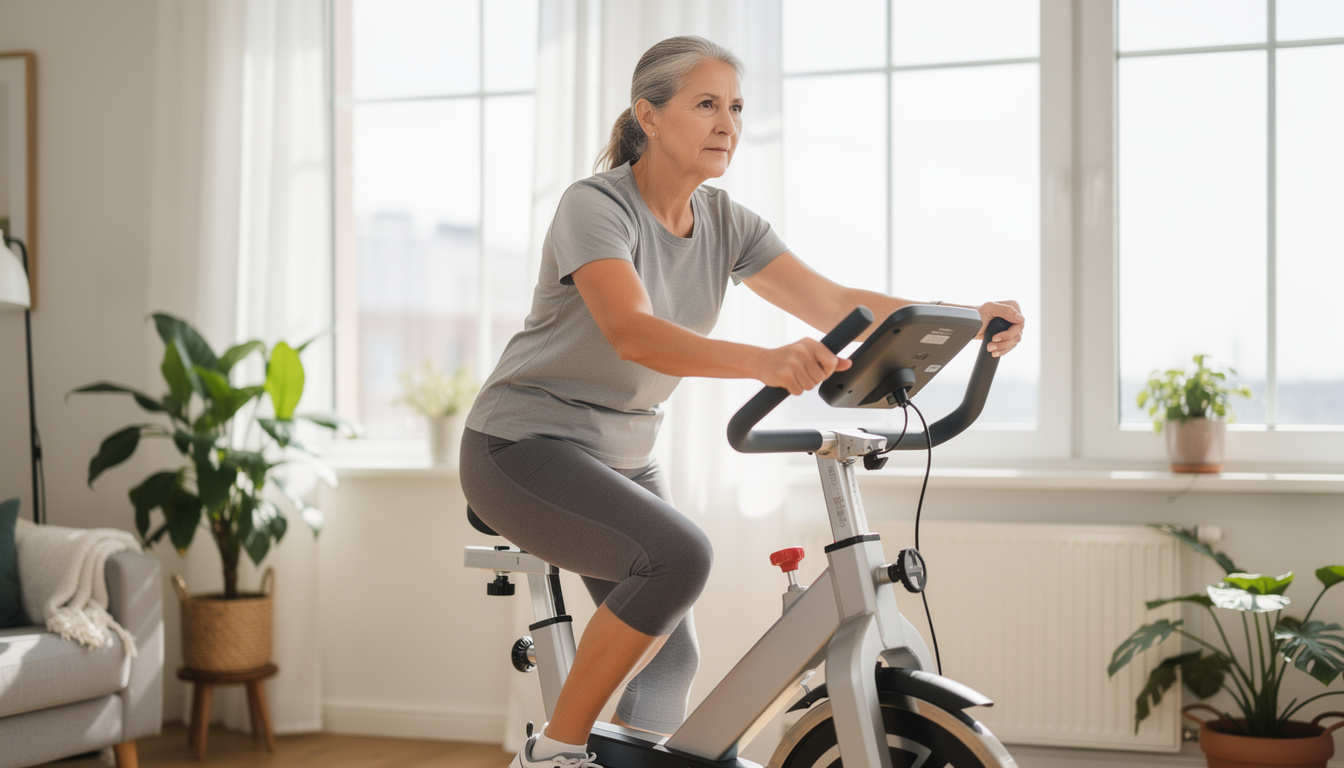
Bike, elliptical, pool running, rowing, or brisk flat walking all fit. Pick the option that lets your pain stay stable during and after the session. For the easy day, work at RPE 4 to 6, where breathing is elevated but controlled.
For the interval day, try 6 rounds of 1 minute hard and 2 minutes easy on a bike or elliptical. The hard minutes should feel like RPE 7 to 8, not a sprint. Research reviews on interval training in adults with joint issues suggest this format can improve cardiovascular fitness while keeping impact low, provided total volume stays sensible.
If you track data, a watch or bike console can help you avoid pushing every session too hard. Our coverage of tech for workouts has a simple theme: metrics help when they guide restraint as much as effort. Knee pain often worsens when every decent day turns into a test.
The Exercises Most People Need to Modify First
Not every classic movement deserves equal priority while the knee is irritated. Some drills are valuable later, but poor choices early can keep symptoms hanging around for weeks.
The first usual suspects are deep lunges, jump squats, burpees, treadmill sprints, and high-volume stairs. These all raise demand quickly. If your knee handles them, fine. If it does not, there is no prize for forcing the issue.
Better Swaps for Common Pain Triggers
Replace a forward lunge with a split squat to a short range, or use assisted reverse lunges with support. Replace jump rope with cycling intervals. Swap treadmill running for incline walking only if the incline does not aggravate symptoms, because steep grades can increase knee demand for some people.
Many adults also benefit from checking basic setup errors. Seat height on a bike matters. On most stationary bikes, a seat that is too low increases knee flexion and can irritate the front of the joint. Small adjustments make a large difference because they change thousands of pedal strokes, not one rep. That is the kind of boring fix that often works.
This is also where context matters for older readers. Several common training mistakes show up in our reporting on workout pitfalls for seniors, and many apply broadly: rushing range of motion, skipping warm-ups, and mistaking soreness for proof of progress. Knees usually prefer competence over ambition.
How to Progress Without Turning a Good Week Into a Bad Month
Progression should be almost dull. Add one variable at a time: five more minutes of cardio, one more set, a slightly higher step, or a modest load increase. Do not change all four together.
A practical rule is to keep weekly volume increases around 5 to 10 percent when symptoms are present. The number is a planning tool, not a law of physics, but it helps many people avoid the classic error of doing too much on the first pain-free week. If you have a history of knee issues, talk to a physical therapist before adding weighted carries, vest walking, or loaded step work.
Warm up for 5 to 10 minutes before each session with easy cycling or walking, then a few rehearsal reps of the first strength movement. Cool-downs matter less than people think, but the warm-up often decides whether the first set feels smooth or stubborn. That is useful information, not a moral judgment.
Signs Your Plan Is Working
Look for better tolerance, not perfect silence from the joint. You want less next-day stiffness, more confidence on stairs, steadier cardio output, and the ability to repeat sessions across two to three weeks. Those trends matter more than one excellent workout.
If pain steadily climbs, swelling appears, or function drops, the plan needs adjustment. The fix may be less depth, fewer sets, lower cadence on the bike, or more recovery days. Precision beats toughness here.
Quick Takeaways for Training Around Knee Pain
Choose low-impact cardio that keeps pain stable during and after the session.
Build lower-body strength through controlled depth, hip-dominant lifts, and modest weekly progression.
Use a 0-10 pain scale and watch the 24-hour response, not just the workout itself.
Consistency usually helps more than heroic single sessions.
What is the best cardio for bad knees?
Stationary cycling, elliptical work, pool exercise, and flat-ground walking are usually the easiest places to start because they reduce repeated landing forces. If front-of-knee pain is your main issue, check bike seat height carefully, since a low seat can increase irritation over long sessions.
Should I stop squatting if I have knee pain?
Not always. Many people do better with box squats, partial-range goblet squats, or TRX-assisted squats because those options control depth and balance. Tempo also matters, and a 3-second lowering phase often helps you find a pain-tolerable pattern.
How often should I work out with knee pain?
A common starting point is 3 to 4 planned sessions per week, with at least one rest or easy day between harder lower-body efforts. Short walks on non-training days can help circulation and maintain daily activity without turning recovery into total inactivity.
Can strengthening glutes help knee pain?
Often, yes, because stronger hips can improve lower-limb control during squats, stairs, and single-leg tasks. Exercises such as hip thrusts, bridges, and controlled step-ups may reduce how much the knee has to compensate for weak or poorly coordinated movement upstream.