
If you want to fix posture desk job aches, stop chasing the perfect sitting position. The better approach is posture variation, short microbreaks, a desk setup that removes obvious friction, and a little strength work for the muscles that hold you up. That mix has better support than any single posture cue, and it’s realistic enough to survive past Monday.
Why “sit up straight” usually fails
Most posture advice dies because it asks you to hold one shape all day. Humans aren’t built for that. Office-pain research keeps pointing in the same direction: discomfort tends to improve more when you combine workstation changes with movement and exercise than when you rely on one isolated fix.
A 2020 review of workplace interventions for low back pain grouped the useful options into two buckets: technical changes, like workstation redesign, and personal changes, like exercise and behavior strategies. More recent 2023-2024 syntheses reported mixed study quality and a lot of variation in program design, but the pattern still favored multi-component plans over single measures. That’s the part generic posture articles usually miss.
So no, your problem probably isn’t that your shoulders rounded for 10 minutes. It’s that your workday has too little movement, too much repetition, and a setup that makes the same tissues do the same job for hours.
Fix posture desk job: the durable framework
If I had to make this stick for a real person with meetings, deadlines, and no interest in turning Tuesday into a mobility retreat, I’d use four levers: change position often, improve the desk setup enough, insert tiny exercise doses during the day, and do some basic strength work outside work. Honestly, this only matters if the plan is frictionless.
| Intervention | Typical dose used in evidence | What studies found | Main caveat |
|---|---|---|---|
| Microbreaks | 1.5-2 minutes every 20-40 minutes | 2019 review described repeated use in office and other settings for discomfort relief and task tolerance | Best for symptom management, not a magic long-term cure by itself |
| Sit-stand workstation | Alternating sitting and standing through the workday | 2018 meta-analysis found a small but measurable reduction in low-back discomfort | Effect size was modest; standing all day is not the answer |
| Workplace resistance exercise | 5-minute sessions during work time for 15 weeks in a 2009 trial | Office-worker reviews through 2021 reported reductions in neck, shoulder, and low-back pain | Programs differed a lot, so there is no single perfect exercise recipe |
| Multi-component approach | Ergonomics plus brief exercise plus microbreaks | 2023-2024 reviews consistently favored this over isolated measures | Evidence certainty for long-term prevention is moderate to low |
The practical takeaway is simple. Don’t hunt for one silver bullet. Stack small fixes that attack the same problem from different angles.
Start with your workstation, but don’t expect miracles
Desk ergonomics matter most when they remove a constant irritant. If your monitor is too low, your laptop forces neck flexion, or your chair height leaves your shoulders shrugged into the keyboard, fixing those things can reduce the amount of strain you accumulate before lunch.
A 2018 meta-analysis found sit-stand desks gave office workers a small but real reduction in low-back discomfort. Trials published around 2021 also suggested reductions in sitting time and some improvement in neck or shoulder discomfort. Small is the key word here. A better desk helps, but it won’t outwork eight hours of stillness.
Use the boring checklist. Screen roughly at eye level. Keyboard and mouse close enough that your elbows can stay near your sides. Feet supported. If you use a laptop, a separate keyboard and mouse usually matter more than obsessing over chair-brand prestige.
If sitting all day is your bigger issue, this breakdown of the hidden cost of sitting and the simplest fix pairs well with a posture plan because it addresses the same bottleneck: too much uninterrupted sedentary time.
Microbreaks that people actually keep doing
Microbreaks sound trivial until you see how often they show up in the evidence. A 2019 review described microbreaks as breaks of up to about 2 minutes, with studies often using 1.5-2 minute breaks every 20-40 minutes. That dosage is useful because it’s short enough to be tolerated and frequent enough to interrupt stiff, repetitive positions.
Here’s the myth to drop: you do not need a full standing desk circuit every hour to get value. Very short breaks count. They just need to happen before discomfort builds, not after you’re already cooked.
- Every 30 minutes, stand up for 60-120 seconds.
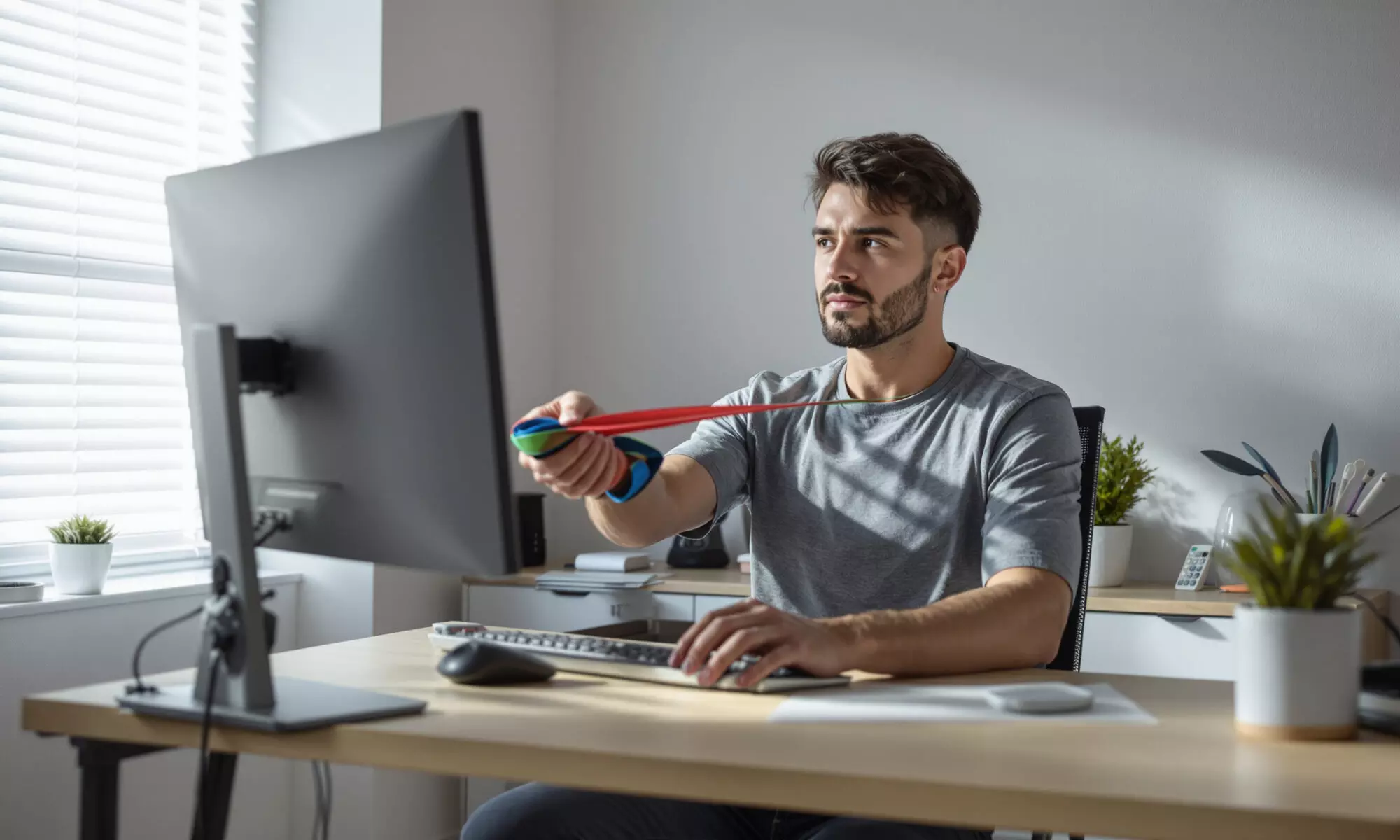
- Do 1 movement for the area that feels loaded: 8-10 band pull-aparts, 5 chair squats, or 20-30 seconds of chest-opening or hip-extension mobility.
- Every 2-3 hours, walk for 2-5 minutes if your schedule allows.
- At least 2 days per week, do a short strength session outside work.
That’s enough for most people. If you want automation, 2026 app listings and updates show the market is flooding with reminder tools such as MicroBreakTime, plus guided-break content from Restier announced on March 31, 2026. I’d treat these as compliance tools, not treatment tools. The evidence is on the behavior, not on a specific app logo.
If your office setup allows it, a walking pad can help you accumulate movement without pretending every break needs a mobility class. A simple walking pad routine is often easier to sustain than a heroic plan built on perfect intentions.
Brief strength work beats endless stretching
Stretching feels nice. Sometimes that’s enough reason to do it. But if your neck, shoulders, and low back keep getting irritated, the better-supported long game is usually some mix of resistance exercise and motor-control work.
A 2020 systematic review found resistance training, stabilization or motor-control exercise, and Pilates-type exercise had a higher probability of benefit for chronic low back pain than control conditions. Workplace-focused reviews through 2021 also reported that short strengthening sessions during work time can reduce neck, shoulder, and low-back pain in office workers. One 2009 workplace trial found improvement after 15 weeks of light resistance training done in 5-minute sessions during work hours.
What I’d do in practice is simple: train the muscles that oppose desk posture and improve your tolerance to staying in one position. Think rows, rear-delt work, split squats, hinges, carries, and trunk stability. You don’t need bodybuilder volume. You need repeatable doses.
A realistic weekly template
Try two 20-30 minute sessions per week. Do 2-3 sets each of a row variation, a hip hinge such as a Romanian deadlift or kettlebell deadlift, a split squat or goblet squat, and one trunk drill such as a side plank or dead bug. Keep most sets around 6-12 reps with 1-3 reps in reserve.
That won’t turn you into a powerlifter. It will give your upper back, glutes, and trunk more capacity, which is often what desk-bound bodies actually lack. For movement ideas that transfer well from sport settings to normal life, these mobility drills for runners include several hip and thoracic options that desk workers can borrow.
The overlooked edge case: pain that isn’t just “bad posture”
Sometimes posture is the story. Sometimes it isn’t. Hand numbness, radiating pain, persistent headaches tied to neck motion, weakness, sleep-disrupting pain, or symptoms that keep escalating despite setup and movement changes deserve a proper assessment.
That matters because “fix your posture” gets used as a catch-all for issues with very different drivers, from workload spikes to stress to actual tissue irritation. If symptoms are significant or persistent, check in with a qualified clinician or physical therapist rather than collecting more Instagram cues.
There’s also a recovery angle people ignore. If your training load, sleep, or stress is poor, your tolerance for desk time often drops with it. Our piece on recovery as a health habit is relevant here because a body that never really recovers is a body that complains faster at the desk.
What changes in 2026, and what doesn’t
The 2026 posture-tech trend is personalization. Since April 2026, apps such as MicroBreakTime have updated around posture and eye-relief reminders, and newer systems are experimenting with guided breaks, adaptive prompts, and even mixed-reality stretching. A June 2026 preprint described a context-aware MR system for adaptive stretching during microbreaks, targeted to body regions the user reported as fatigued.
That’s interesting, but keep the evidence hierarchy straight. Most of the stronger support still comes from older systematic reviews, meta-analyses, and workplace exercise trials, not from tiny pilots or product announcements. A 2026 Cureus quality-improvement pilot in nine junior residents improved median ergonomic scores after lecture plus hands-on training, but the changes were not statistically significant. Useful signal. Very limited certainty.
So the flashy version of posture care is evolving. The boring version still wins: reminders, position changes, a tolerable workstation, and enough strength and movement to make desk time less costly. If daily walking is your easiest compliance tool, making walking a routine helps for more than stress.
FAQ
Can you really fix posture from a desk job?
You can usually improve comfort, movement habits, and how long you tolerate desk work, yes. The research supports multi-component plans more than trying to hold one perfect posture all day.
How often should I take posture breaks at work?
A practical evidence-based target is 60-120 seconds every 20-40 minutes. If that feels too frequent for your workflow, start every 30 minutes and build from there.
Are sit-stand desks worth it for posture?
They can help, especially for reducing sitting time and slightly lowering low-back discomfort, but the effects are usually modest. They work better when paired with microbreaks and brief exercise.
What exercises help desk posture the most?
Rows, rear-delt work, hinges, split squats, carries, and trunk stability drills are strong bets because they build capacity in the upper back, hips, and trunk. Short workplace resistance sessions and basic home strength work have better support than endless stretching alone.
Why does my posture get worse when I’m tired or stressed?
Because posture is partly a load-management problem, not just a positioning problem. Poor sleep, high stress, and hard training can lower your tolerance to static work and make desk discomfort show up faster.